

Where to start a business without experience
People searching for a business to start usually begin with an idea: a shop, café or service. But beginners lack experience more than ideas. They do not know where money is lost in the chosen business and discover this after investing.
Replace which business should I choose with how much time and skill will it require every day? The answer determines which mistakes you can afford and which you cannot.
Every first-time business owner goes through five steps: format, calculations, location, launch with registration and first customers. The sequence matters because each step builds on the previous one.
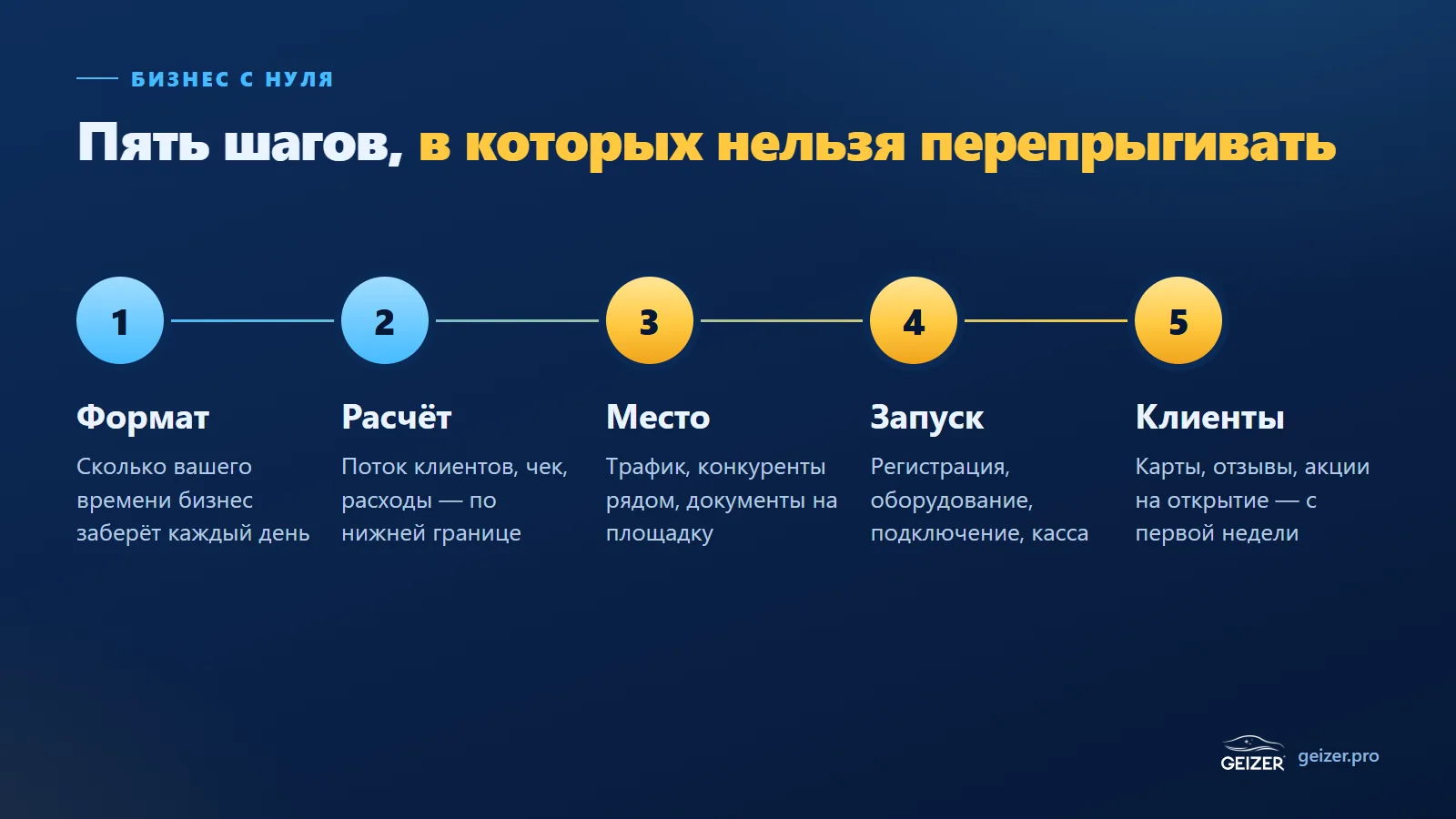
Step 1. A format matching owner involvement
Any small business can be described by three questions. Does it need staff, and who manages them? Does it involve buying stock and managing inventory? How many decisions does the owner make every day?
- A business based on personal skills. Services, repairs and a workshop. Entry costs are usually lower, but work stops without you and holidays mean downtime.
- A business with staff and goods. Retail or food service. You must recruit, train, buy stock and monitor expiry dates and inventory. For a beginner, that means several new professions at once.
- An equipment-based business. Customers serve themselves while the owner monitors machinery, consumables and revenue. Staffing is lower, but entry costs more and location matters greatly.
Starting with minimal investment almost always demands more of your time: work not bought with money must be done manually. Be honest about how many hours you can give in the first months. If you keep a salaried job, a format that stops without its owner is unlikely to fit.
Choosing a business: five questions to ask yourself
Lists of the best beginner ideas help little: they know neither your city, money nor schedule. The same idea succeeds for one owner and closes for another because one can be there every day and the other cannot.
Before choosing, answer five questions. Write the answers down: on paper, it is easier to spot where you are persuading yourself.
- How many hours a week can you commit? Not in your best week, but a normal week with work, family and illness.
- How much can you lose without harming your family? Not how much you have, but how much you can bear losing if the business fails.
- What can you already do? Selling, calculations, repairs and negotiation. Every existing skill removes a risk; missing skills must be bought or learned along the way.
- Is there demand where you live? What works in a big city may not sustain itself in a small town, and vice versa.
- Are you ready for the routine? Think not of opening day, but an ordinary Tuesday six months later. Picture what you will be doing that day.
Then test the business through a customer's eyes. Visit several operating locations at different times, see how busy they are and what annoys customers. If possible, talk to an owner in another city: you are not their competitor there, so they may discuss pitfalls more openly. Popular formats are covered in What business to start in 2026 and Business in a small town.
Steps 2 and 3. Conservative calculations and location
Beginners' calculations are almost always optimistic: the best traffic, best average transaction and no downtime. Reverse that approach. Use the lower limit of researched demand and see whether the project works. If it only works when everything goes well, it is a hope rather than a plan.
Include not only startup investment but a reserve while customers are still discovering you. List expenses independent of revenue separately: rent, taxes, salaries and loan repayments.
Location is almost impossible to correct later. For businesses relying on passing customers, it affects demand more than advertising. Before signing a lease, observe pedestrian or vehicle traffic at different times, nearby competitors and surrounding residents. Our car wash approach is explained in How to choose a city and site.
Starting with minimal investment: where to save
Minimal investment shifts costs rather than defining a separate business type. What you do not pay in money, you pay in time, manual labor or risk. A skill-based business can start modestly, but you are its main equipment: if you are ill, there is no revenue.
You can lower entry costs without affecting customers:
- Test demand before major spending. Trial sales, preorders and first customers through acquaintances: anything showing interest before you buy premises and equipment.
- Rent instead of buying. Renting premises or land is usually wiser at the start: money stays in reserve rather than walls.
- Start smaller. One outlet instead of two, a focused range and fewer places. Expand when real demand becomes visible rather than relying on forecast demand.
- Avoid spending on things customers do not notice. An expensive office, unnecessary furniture or advertising before the product is ready.
Do not cut costs on things that cannot be fixed later: location and core equipment. Nor on the reserve: a small project without first-months savings is often riskier than a larger project with a buffer.
The smallest self-service wash starts with one bay. GEIZER has no initial franchise fee, so money goes into equipment rather than permission to use the brand. But the bay also needs a site, connections and canopy, so minimal investment here remains a substantial sum. Its components are explained in how much it costs to open a self-service car wash.
Steps 4 and 5. Launch, registration and first customers
People often register first, though there is no need to rush: legal form and tax regime depend on what you open, with whom and at what scale. Choose the regime with an accountant using your calculations, not acquaintances' advice. For washes, see Taxes and registration.
Launch is a sequence rather than opening day: site agreement, connections, supply and installation, operation checks and training. The longest tasks are usually outside your control, such as approvals and power connections. Start them before everything else.
First customers do not arrive by themselves. Make sure people can find you on maps, the entrance has clear signage and the first visit is convenient. During the first weeks, gather reviews and ask how customers found you: this is the cheapest demand data you will have.
Starting a business: before the first payment
The most expensive startup mistake is paying before checking. Divide the beginning into two phases: actions costing almost nothing and payments that make retreat expensive.
Before the first major payment:
- Write down the weekly hours and amount you can commit, including a reserve.
- Visit several operating locations of the chosen format as a customer.
- Calculate using conservative demand and list costs independent of revenue.
- Observe the site at different times and on different days.
- Discuss the choice between an individual entrepreneur (IP) and a limited liability company (OOO), and the appropriate tax regime, with an accountant using your calculations.
- Read the lease and supply agreements in full and understand the consequences of termination.
Opening is not the end of starting a business. In the first months, forecast demand gives way to reality. Check revenue daily rather than monthly, compare it with the conservative forecast and keep the reserve intact until you have seen ordinary trading days, not just opening days.
At a self-service wash, owner-account data provides this picture: revenue by bay, utilization and fault alerts. What owners see is explained in Online wash management.

Common beginner mistakes
- Starting with the idea instead of the format. The business is appealing but requires daily presence the owner cannot provide.
- Using averages. Market averages say nothing about a specific address.
- Spending everything on launch. There is enough to open but not to survive the months needed to build traffic.
- Cutting corners on essentials. Cheap equipment or a poor location costs more than the price difference.
- Failing to track performance. Without clear revenue monitoring, the owner hears about problems last.
Why an established model reduces beginner risk
Most mistakes stem from inexperience. You can gain experience at your own expense or use a model whose path has been repeated many times: a franchise or equipment with manufacturer-managed launch.
An established model does not remove risk, but it reduces unknowns. The format is tested, calculations use operating-site data, experienced people assess the location and installation and training follow an established process. What nobody can do for you remains yours: the decision, money and site oversight.
Check an established model as strictly as your own idea: what supports the calculations, what the price includes and who handles breakdowns. The two options are compared in franchise or equipment.
A self-service wash as an example
A self-service wash illustrates the equipment-based format. Customers wash their own cars and pay at the bay by card, SBP or QR code. Staffing is minimal: someone cleans the grounds, refills chemicals and does minor jobs. The owner sees bay revenue, utilization and fault alerts on a phone and changes prices and promotions in the same account.
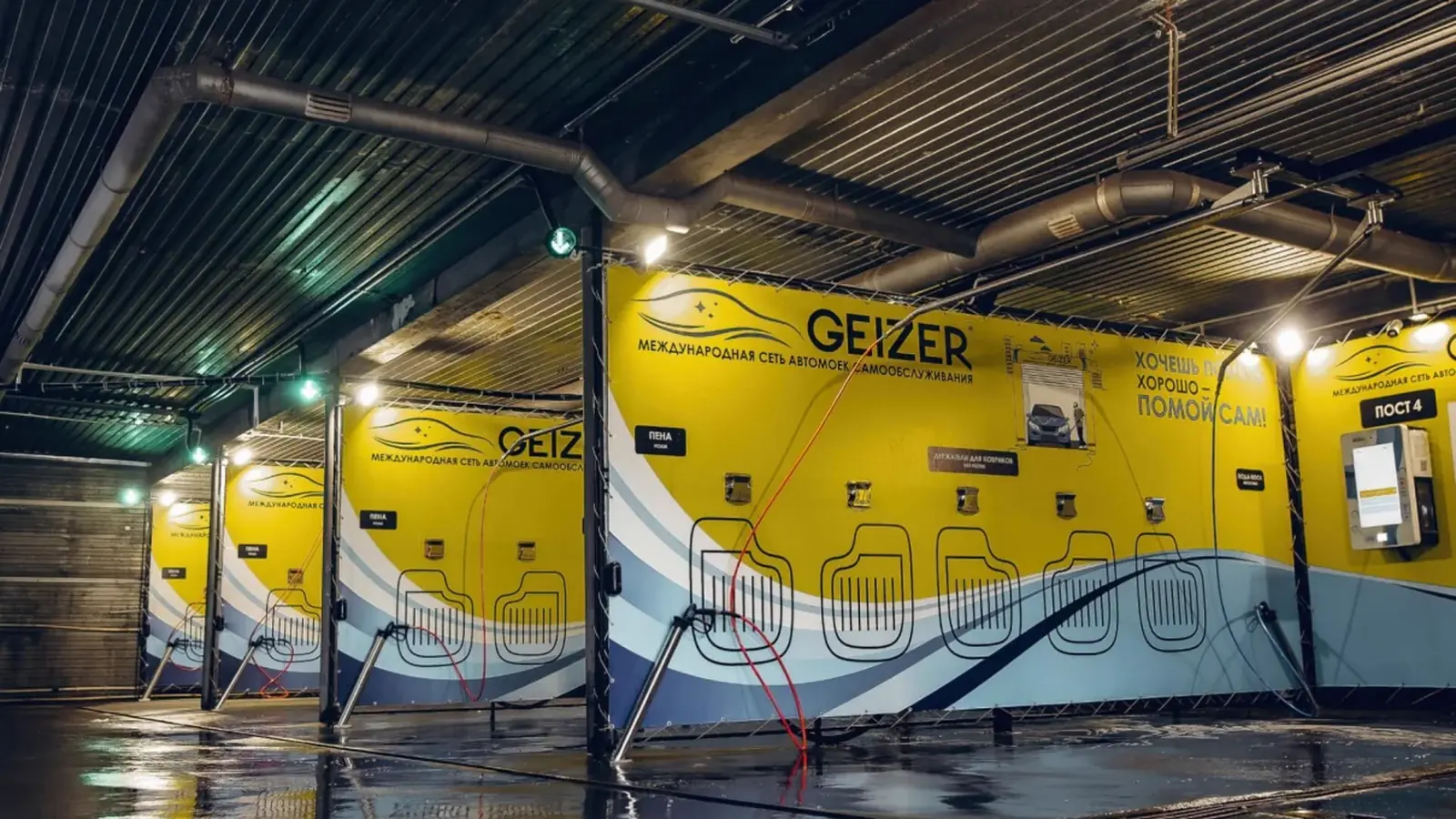
This is not passive income: the owner's involvement covers oversight, chemicals and cleaning, which should be understood beforehand. For more, see Passive income: myths and reality.
In the GEIZER franchise the initial fee is 0 ₽ and royalties of 5% apply to revenue from an operating wash. BRIZ bay equipment with delivery, installation, commissioning and training starts at 450,000 ₽, and washes open with 1 to 6 bays. Site preparation, connections, canopy, signage and paperwork are assessed separately after inspection. Before launch, we assess traffic, competitors and residential areas and advise how many bays the location can support. The network has 199 washes in 69 cities operated by 147 partners; manufacturing in Barnaul has operated since 2015.
Two bays serving 40 cars a day each at 250 ₽ produce 600,000 ₽ monthly revenue. Site expenses of around 35% are 210,000 ₽;5% royalties are 30,000 ₽. That leaves 360,000 ₽ before rent, taxes, salaries and loan payments. This is a preliminary estimate, not an income guarantee: network traffic ranges from 20 to 120 cars per day per bay and depends on location.
Start as any new business should: calculate conservatively. Enter your own figures in the income calculator or view the Network citiesto see whether there are washes near you.
Frequently asked questions
Where should I begin without business experience?
Choose a format according to the owner's involvement: how much time and skill it needs every day. Then calculate conservative demand, select a location, launch with registration and attract first customers. The idea matters less than whether you can sustain the format.
What should I do before making the first investment?
Write down how much time and money you can commit to the business, including a reserve, calculate the project using the lower estimate of demand, and visit the location at different times. Discuss the choice between registering as an individual entrepreneur (IP) or a limited liability company (OOO), and the tax regime, with an accountant using your figures. Read rental and supply agreements in full before signing, including their termination terms.
What business should a beginner start?
One where mistakes caused by inexperience cost the least. If you cannot be present daily, consider equipment-based self-service formats. If you have skill and time but little money, choose a business based on your own skills.
How do I choose a business to start from scratch?
Ask five questions: how many hours a week can you commit, how much can you lose without harming your family, what can you already do, is there demand in your city, and are you willing to handle the routine? Then visit several operating sites as a customer. If possible, talk to a similar business owner in another city, where you are not a competitor.
Can I start from scratch with minimal investment?
Yes, but lower investment almost always means more of your own time and labor. What money does not buy, you must do yourself. Include a reserve for the months needed to build customer traffic, not just the initial sum.
Where can I save when starting with minimal investment?
Things customers do not notice: an expensive office, unnecessary furniture or advertising before the product is ready. Renting premises is usually more sensible at first, and starting smaller lets you scale with real demand. Do not cut corners on location, core equipment or the first-months reserve.
What mistakes do first-time entrepreneurs make?
Starting with an idea instead of a format, using market averages rather than a specific address, spending everything on launch without a reserve, cutting corners on location and equipment, and failing to track revenue. Most stem from inexperience.
Is a franchise suitable without business experience?
A franchise or equipment with a manufacturer-managed launch reduces beginner risk: the format is tested, calculations use operating-site data and launch follows an established process. It does not remove risk, so check the figures, what the price includes and who handles breakdowns.