

Choosing a business: four questions before the idea
People usually start with an idea list. Start with yourself instead: available time, managing people and willingness to hold money in goods. The same idea can work for one owner and exhaust another.
- Owner involvement. Will you work at the counter, serve customers or only oversee? If dependent on your presence, it is a job rather than an investment.
- Staff. Employees mean hiring, training, shifts and cover for illness and holidays. Staffing is often a beginner's first difficulty.
- Inventory. Purchasing goods keeps some money permanently in stock. Goods may not sell, spoil or go out of fashion.
- Nearby demand. Enough customers must be within walking distance or a short drive. An idea successful in a large city may find no buyers in a small one.
A good beginner idea has reassuring answers to all four: clear involvement, few staff, little stock and demand testable before investment.
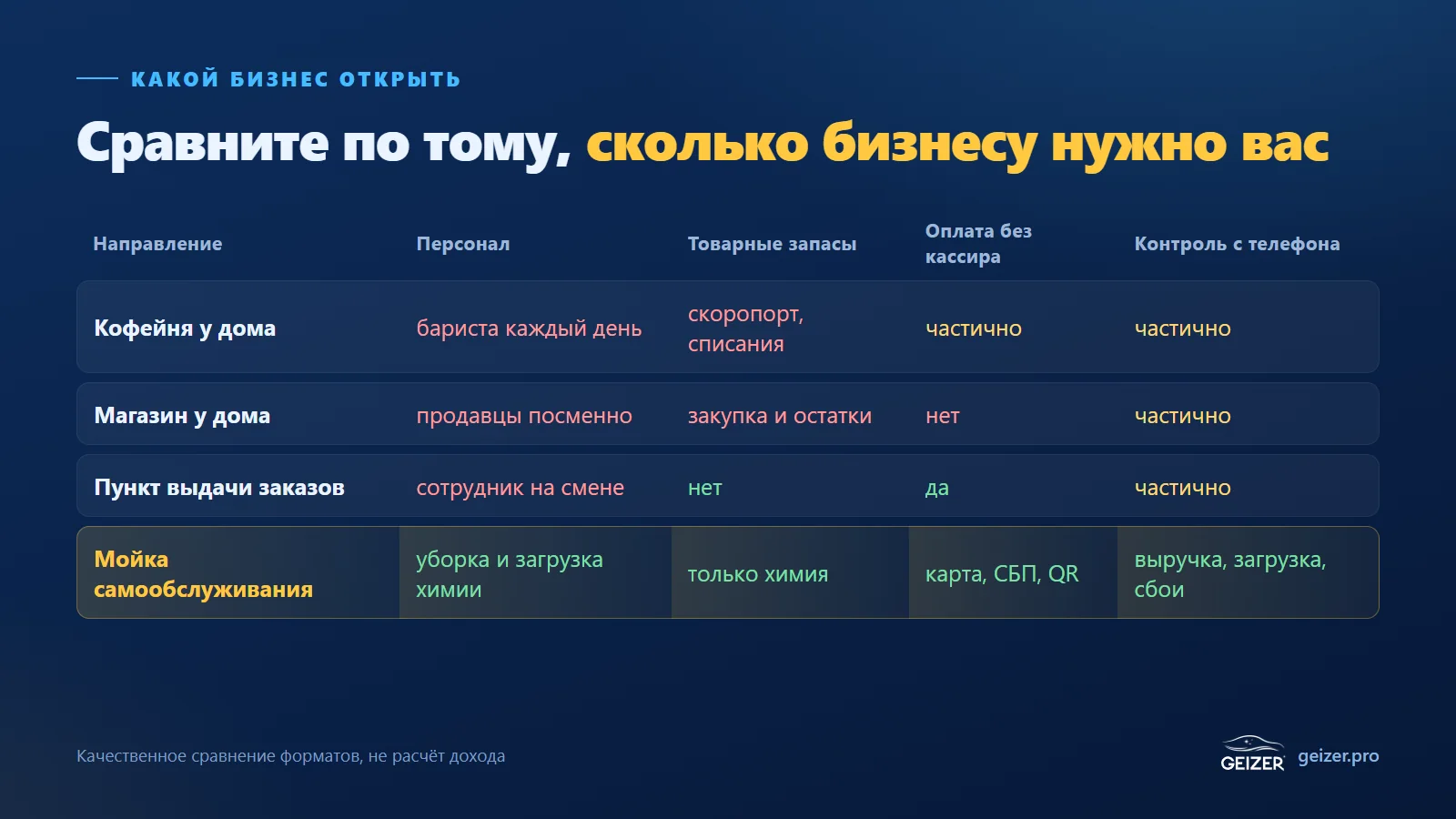
Business ideas for 2026: six realistic directions
These are commonly considered formats, including searches for low-investment ideas. Figures are deliberately absent: income and costs depend on city and location, and others' averages obstruct your calculation.
- Food service: café, bakery, takeaway. Clear daily demand, but every shift needs staff, perishable purchases and strict hygiene compliance. Owners are usually deeply involved, especially in year one.
- Neighbourhood shop. Relies on customer habits but needs inventory capital, salespeople and constant range management. Leftover stock and write-offs are part of the business.
- Services: salon, workshop, repairs. Little stock and usually less entry cost than retail. But it depends on specialists: a strong technician leaving often takes customers too.
- Online retail. No street premises, but purchasing, storage, returns, advertising and nationwide price competition remain. Owner involvement is nearly full-time.
- Motorist services: tyres and detailing. Demand follows nearby car numbers and season. Specialists are needed, and tyre work peaks heavily at seasonal changes.
- Self-service car wash. Almost no staff or merchandise inventory; customers wash and pay at the bay. Owners handle oversight, chemicals and cleaning. The constraint is a suitable site and connections.
No format is inherently best. The difference is the resource committed: time, people management or inventory money. If time is scarce, look at formats where equipment works instead of an employee shift.
Beginner businesses: common mistakes
Beginners lack experience to test intuition against. Most common mistakes concern money and time rather than the idea.
- Choosing taste over demand. You want your favourite type of café or hobby shop. What matters is how many nearby people will pay regularly, not your taste.
- Calculating from the best day. Revenue is estimated from a neighbour's Saturday queue or an owner's story, omitting weekdays, bad weather and quiet months.
- Spending all money on launch. Business rarely reaches normal traffic on day one. Without rent and payment reserves, any delay becomes a crisis.
- Underestimating preparation. Premises, connections, permits and agreements take time, during which the business earns nothing.
- Quitting work immediately. Until business figures are proven, your main salary is a safety cushion.
Three things help: documented processes, a small first step and a lower-bound calculation. A ready model, a franchise or detailed experience of similar owners, prevents some mistakes but leaves location, money and decisions your responsibility.
Franchising costs usually include an initial fee and revenue royalties. Check what they buy: training, supplies, support and management software, and when payments begin. GEIZER has no initial fee; 5% royalties apply to operating revenue. We explain worthwhile versus empty franchises in the article franchises in 2026: choosing a worthwhile one, and starting without experience in the article business from scratch: where to begin.
Low-investment ideas: what the amount really includes
Entry prices for equipment, first goods or franchises are usually compared. But funds go elsewhere too; an honest total has several parts.
- Location. Rent, deposit, renovation or site preparation. Payment often begins before the first customer.
- Connections and documents. Electricity, water, permits, agreements. Easily forgotten initially, they affect both budget and timing.
- Working capital. Goods or consumables, launch advertising and wages before the business supports itself.
- Reserve. Money for quiet months and surprises. Without it, one bad season can close a good idea.
The cheapest entry often relies on you: hands-on services, resale or personal skills. Little money is needed, but when you stop, income stops. This is closer to self-employment than a business running without daily presence.
Count investment in two currencies: money and your hours. Less upfront money usually means more daily time. Equipment needs more initial capital but reduces dependence on employee shifts and your own.
A self-service wash's minimum step is one bay: the GEIZER franchise starts at 450 000 ₽ with delivery and launch; site and connections are separate. The full estimate is in the article how much it costs to open a self-service wash, and equipment versus franchise in the article franchise or equipment: what to choose.
Self-service wash: minimal owner involvement
Customers arrive, choose settings and wash themselves. Card, SBP or QR payment at the bay removes the cashier and shift administrator. Equipment works from −35 to +35 °C, so the wash does not close for winter.
“Minimal” is not “none”. Someone cleans, loads chemicals and handles small tasks; hours depend on bays and traffic. The owner's remaining work is honestly explained in the article car wash as passive income: myths and reality.
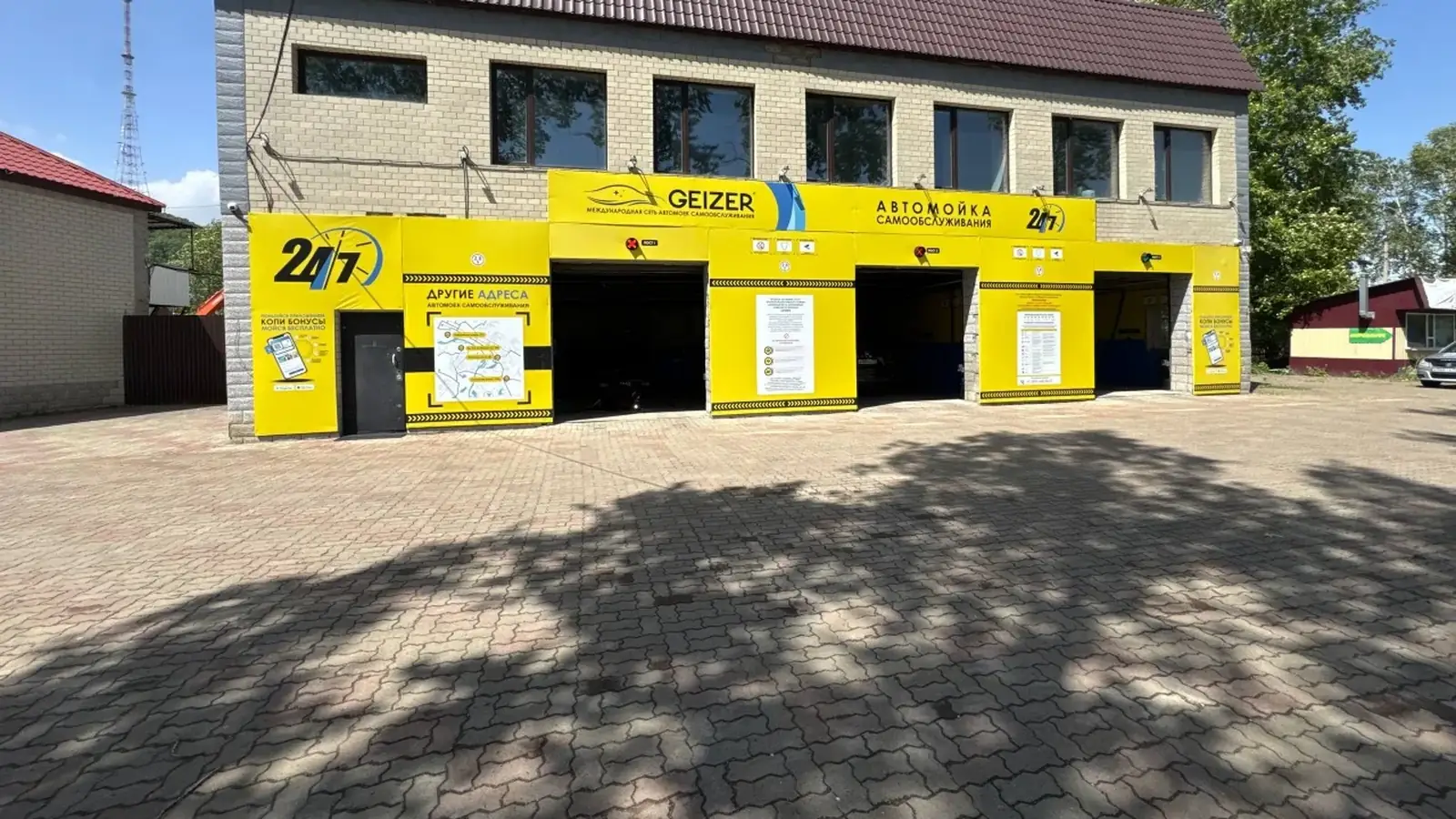
Other management moves to the phone: bay revenue, utilisation, peak hours and fault alerts before customer complaints. Prices and promotions change remotely, and multiple sites share one system. Customers have the GEIZER app with loyalty and promotions.
Open with one to six bays matching immediate traffic. GEIZER has 147 partners, more than 400 bays and 199 washes in 69 cities, owned by partners rather than the company. BRIZ has been manufactured in Barnaul since 2015. The complete model is explained in the article self-service wash as a business.
Entry cost and a sample calculation
BRIZ equipment starts at 430 000 ₽ per bay from the factory. The GEIZER franchise includes delivery, installation, commissioning and training from 450 000 ₽ per bay, or 900 000 ₽ for two. Initial fee: 0 ₽; 5% revenue royalties start only after opening.
Site, connections, canopy, signage and documents are excluded and calculated after inspection. Minimum per bay: wash area 39 m², parking 30 m², 380 V at 7–12 kW, water 14 L/min, utility room from 4 m² and septic capacity from 6 m³.
Two bays, 40 cars per bay daily, 250 ₽ average transaction and 30 days yield 600 000 ₽ monthly revenue. Chemicals, water, electricity, cleaning and maintenance cost about 35%, or 210 000 ₽. Royalties at 5% are 30 000 ₽, leaving 360 000 ₽ before rent, taxes, wages and loans. This is preliminary, not an income guarantee.
Network traffic ranges from 20 to 120 cars daily per bay; the calculator's transaction range is 180 to 400 ₽. Location creates the spread, so there is no universal payback: from 6 months is a best case at high utilisation, not typical. Enter your figures in the income calculator.
What to open in a small town: test for your city
Every idea is tested the same way: specific local demand first, money second. Especially important in small towns, where customers are fewer and location errors more costly.
Small towns have fewer customers but usually fewer competitors; one good site may cover a whole neighbourhood. Reputation travels quickly both ways: good service through acquaintances, bad service even faster. Recurring everyday demand is safer than purchases once every few years.
Narrow, fashionable ideas needing many passing buyers fare worse. Large-city population may sustain an audience that a small town never achieves. Suitable formats are discussed in the article small-town business: ideas that work.
- Observe traffic. Count people or cars on weekday evenings and weekends, personally and at different times.
- Find nearby competitors. Who operates, whether queues form and what customers lack.
- Assess housing nearby. Everyday-demand businesses live on residents and regular passing traffic.
- Calculate cautiously. Use lower-end traffic and neighbouring prices. If it works, the idea is viable.
- Check site and documents before buying equipment. Connections and permits often take longer than launch itself.
For a small-town wash, a cautious scenario is near the network's lower range, 20 cars daily per bay rather than 120. Match bays to immediate traffic. The network includes small towns such as Birobidzhan.
For self-service washing we test this with you before launch: traffic, competitors, housing, site and documents, then advise bay count. See which cities already have the network, and read how to choose a city for a wash.
Your 2026 business choice follows four answers, not an idea list: your time, people, inventory capital and nearby demand. Self-service washing is one option whose answers are known beforehand and tested by calculation.
Frequently asked questions
What business should you open in 2026?
One matching your time, people-management skills and willingness to tie money up in goods. Use four criteria: owner involvement, staff, inventory and nearby demand. Test the idea for a specific location, not someone else's averages.
What business needs minimal investment?
Services without stock usually need the least money but depend on your work or specialists. If minimal involvement matters more than entry cost, consider equipment-based formats. A GEIZER franchise self-service bay starts at 450 000 ₽ excluding site and connections.
What business should you open in a small town?
Everyday-demand businesses with nearby residents or traffic and few staff. Location mistakes cost more in small towns, so count traffic and competitors first. A self-service wash can start with one bay and expand later.
What business suits beginners?
Beginners have an easier start with few employees, no merchandise stock and demand testable before investment. Staff and working-capital management are hardest initially. Use a cautious scenario: if it works, the idea is viable.
How much does opening a self-service wash cost?
BRIZ equipment starts at 430 000 ₽ per bay from the factory. The GEIZER franchise includes delivery, installation and training from 450 000 ₽ per bay, or 900 000 ₽ for two. The initial fee is 0 ₽; 5% royalties start only after opening. Site, connections, canopy, signage and paperwork are separate after inspection.
What business can a beginner open without quitting work?
One needing no presence during working hours, counter shifts or appointments personally with you. Equipment-based formats fit better, letting owners oversee them in free time. Self-service washes, for example, are managed by phone, but owners remain responsible for location, chemicals, faults and accounting. Keep the main job until real business figures are proven.
What does minimum business investment include?
Not just equipment, initial goods or franchise entry. Add premises rent, deposit and preparation, connections and documents, working capital for purchases and advertising, and reserves for the first months until traffic builds. Counting entry price alone underestimates the real amount.
Can you open a nearly staff-free business in a small town?
Almost nothing works without people, but some formats need site servicing rather than a person behind the counter every shift. At self-service washes, customers wash and pay themselves; someone cleans, loads chemicals and does minor tasks. Start with one bay for the specific location's traffic.