

How small-town business differs from big-city business
Cheap rent often comes to mind when choosing a small-town business. But the main difference is demand, not prices. The principles are the same as in a big city; mistakes simply become visible sooner.
- Fewer competitors. Many niches have one or two outlets, and some have none. There are fewer customers too: a second identical shop next door merely divides the same demand.
- Everyone knows everyone. Word of mouth works faster than advertising in both directions. People discuss good service and remember bad service for a long time.
- Everyone has a car. Buses run less often, so people drive to work, gardens and nearby villages. Car-related services are needed regularly rather than occasionally.
- A shortage of services. Services available on every corner in a big city may be hard to find here or require a trip to the regional capital.
The rule is simple: small towns support recurring everyday needs better than fashionable concepts or narrow audiences.
Small-town business ideas that work
Successful formats have common features: frequent use, no easy replacement through a neighboring-city trip and no dependence on trends.
- Car services. Tire fitting, minor repairs and washing. Cars get dirty and wear out in every town, and people drive them daily.
- Household services. Appliance and clothing repairs, dry cleaning and hair salons. Demand is steady, and the whole town soon knows a good craftsperson.
- What people travel to the regional capital for. If residents regularly bring something back from a bigger city, that signals a service they need but cannot find locally.
- Parcel pickup and delivery. Online shopping is common beyond big cities, and people prefer collecting purchases near home.
Ask not whether an idea is fashionable, but how often people need it. More frequent needs produce steadier traffic.
Small-town business ideas: advantages and drawbacks
There is no perfect idea: each format has strengths and weaknesses. Here are common small-town options and lessons often learned only after opening.
- Tire fitting. Advantage: almost every driver needs spring and autumn tire changes, so seasonal queues form naturally. Drawback: traffic falls between seasons, the work is physical and relies on skilled staff.
- A small car repair shop. Advantage: maintenance and repairs are always needed, and a good technician becomes known quickly. Drawback: premises, tools and experienced staff are needed, and you are responsible for repair quality.
- A hair salon or barbershop. Advantage: steady demand and small premises. Drawback: customers often follow the stylist rather than the salon and leave when the stylist leaves.
- Appliance and phone repair. Advantage: you can start with very little investment in a small workshop. Drawback: earnings depend on your time, and spare parts often need to be ordered and awaited.
- A parcel pickup point. Advantage: the platform brings traffic, so little advertising is needed. Drawback: the marketplace sets and may change terms, a person must handle collections all day, and a competitor can easily open nearby.
- A coffee shop or small café. Advantage: a meeting place the town may lack. Drawback: food spoils, every shift needs staff and the few busy locations attract competition.
- Services for homes and gardens. Mowing, rubbish removal, snow clearing and minor repairs. Advantage: simple tools allow a low-cost start where detached homes are common. Drawback: seasonal, physical work.
- Self-service wash. Advantage: no vehicle washers or cashiers, around-the-clock operation and a one-bay start. Drawback: location decides everything, the site needs water and 380 V electricity, and investment exceeds a manually provided service. More below.
For more formats and their economics, see What business to start in 2026.
Formats that work less well
Failures in small towns also repeat. Usually quality is not the problem; the format does not match market size.
- A narrow niche. An idea with enough regular customers in a million-person city may not attract enough in a small town.
- Copying a big-city concept. Interiors, menus and prices designed for a big city may not fit local habits.
- A business dependent on one person. If the specialist is ill or leaves, the outlet closes. Finding a replacement in a small town can be difficult.
- A large stock purchase. Inventory ties up money, and a small customer base means clearing leftovers takes longer.
What business the town needs: assessing demand yourself
Small-town market research usually does not exist. But a few days looking at the town as a customer reveal almost everything needed.
- Count competitors. Use maps, listings and street signs to count operating sites in your niche and locate them. Visit as a customer: waiting times, service quality and review complaints matter.
- Look at queues. Weekend queues or bookings far ahead signal demand exceeding supply. An empty room at peak hours suggests the opposite.
- Count cars. Walk through courtyards and residential streets in the evening when people are home and count parked cars. Observe passing traffic near the future site morning, afternoon and evening. For any car-related service, these vehicles represent your audience.
- Ask what people travel to the regional capital for. Ask acquaintances, colleagues and local social-media or messenger groups. Questions such as where in town can I do this, which nobody can answer clearly, provide a ready-made list of niches.
- Find out what closed. Empty premises with old signage show what the town did not support. Find out whether location, prices, service or the idea itself was responsible.
This does not forecast revenue. It answers whether demand exists and how you will improve on current providers. If you cannot answer the second question, finding another niche is better than dividing the same small customer flow.
Seasonality: businesses that work all year
Small towns have fewer customers, so holidays, gardening seasons and celebrations affect revenue more. Before launching, understand the whole year rather than one successful month.
- Steady demand. Household services, repairs, hair salons and pickup points are needed all year, although they too have quiet weeks.
- Peaks and troughs. Tire fitting peaks in spring and autumn, home and garden services in summer and snowfall, while clubs and tutors follow the school year.
- Everything related to cars. Cars get dirty all year: mud in spring and autumn, road chemicals in winter and dust in summer. Wash demand changes with weather but does not disappear. Seasonal patterns are discussed in How often to wash your car.
The practical lesson is to calculate whether you can survive the worst month. If fixed expenses such as rent, salaries and loans consume all revenue in a downturn, add a quiet-season service or a reserve to bridge it.
Minimal-investment business in a small town
Minimal is misleading. A service performed with your own hands is cheapest, but income depends on your time. As soon as premises and employees appear, both investment and fixed expenses rise, regardless of revenue.
Consider three questions beyond startup cost: how many staff are needed, whether goods must be purchased, and how many hours you personally must work each day. Hiring is harder in a small town, so low staff dependence is a real advantage.
Also ask what happens if you travel or are ill for two weeks. If the business stops, you have bought yourself a job rather than a business. That is not bad, but make the choice consciously.
For a very small budget, consider skills-based services: appliance repair, handyman work, mowing, snow clearing or tutoring. They share a limit: growth follows your available time, and moving beyond it requires staff or equipment.
Reserve money for the first months separately. In small towns, word of mouth builds traffic gradually and initial revenue may not cover costs. For starting without experience, see Starting a business from scratch: where to begin.

A self-service wash in a small town
Self-service washing matches small-town conditions: many cars and few services for them. Customers wash themselves and pay at the bay by card, SBP or QR code, so vehicle washers and cashiers are unnecessary.

- Start with one bay. A wash can open with 1 to 6 bays. One bay needs 39 m² of washing area,30 m² of parking,380 V electricity at 7–12 kW, water at 14 L/min, a utility room from 4 m² and a septic tank from 6 m³.
- Around the clock without shifts. No need to find night-shift staff. Someone cleans, refills chemicals and handles minor jobs; the hours depend on bays and traffic.
- Winter is no obstacle. Equipment operates from −35 to +35 °C. For the cold season, see Self-service washing in winter.
- Management from a phone. The account shows revenue by bay, utilization, peak hours and fault alerts before customers complain. Prices and promotions can be changed remotely.
This is not theoretical. GEIZER has 199 washes in 69 cities, including small towns and villages as well as major cities. Partners own the washes, and BRIZ equipment has been manufactured for them in Barnaul since 2015.
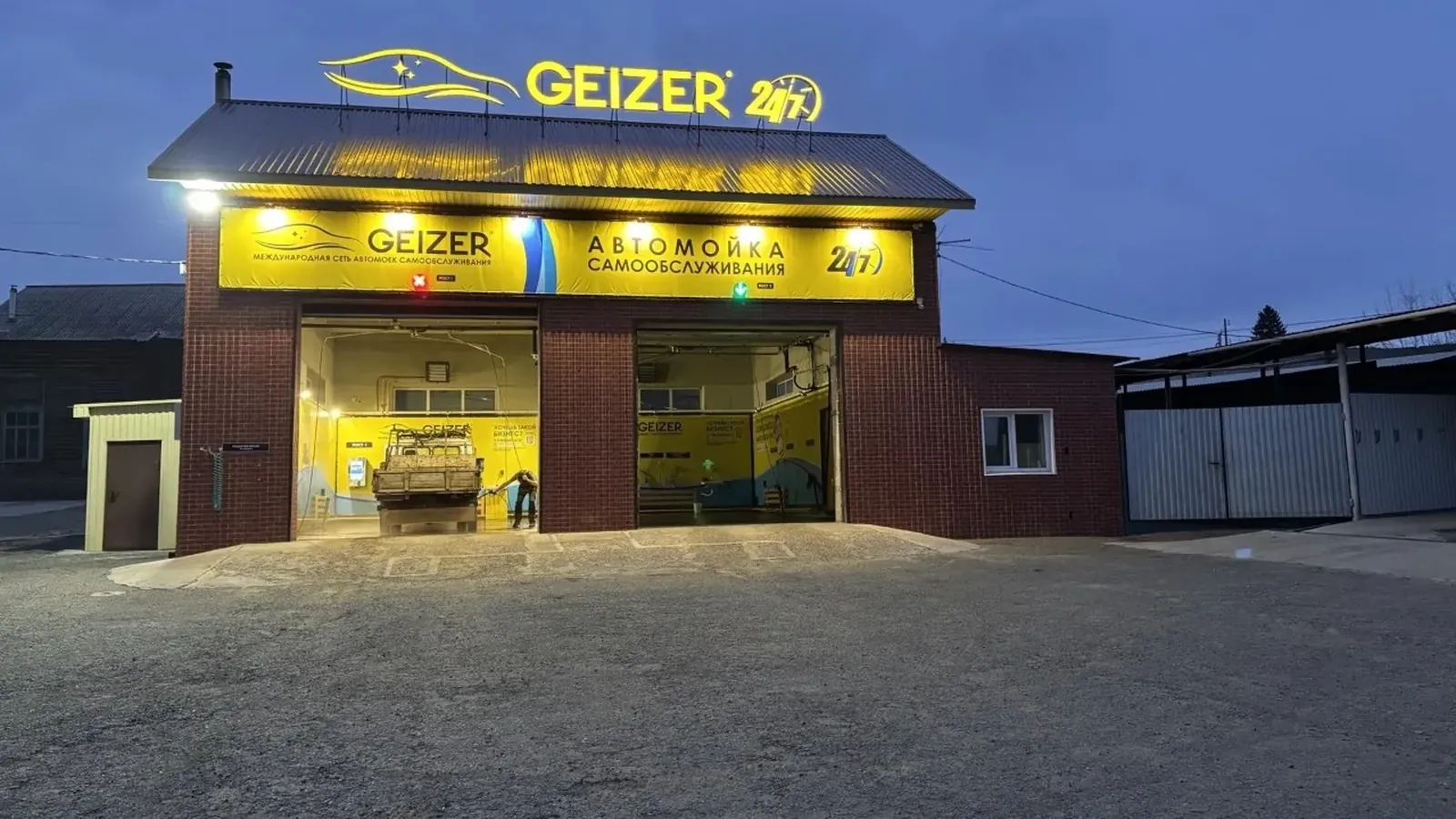
Franchise bay equipment starts at 450,000 ₽ including delivery, installation, commissioning and training. There is no initial franchise fee;5% royalties apply only to operating-wash revenue. Site preparation, connections, canopy, signage and paperwork are separate after inspection.
Applying the low-investment questions gives this picture: little staffing, no goods on shelves, only chemicals as consumables. If you leave for two weeks, the wash keeps working provided someone cleans and refills on site; you monitor revenue and faults remotely. But the owner remains responsible for location, chemicals, breakdowns and records, and investment exceeds a manually delivered service because equipment, land and connections are needed.
This is not income without involvement: oversight, chemicals and cleaning remain. Network traffic ranges from 20 to 120 cars per day per bay, and location determines your result. For more, see Passive income myths.
How to assess your town
Before choosing a format, view the town as a customer. Three things matter for a self-service wash.
- Traffic. Where cars pass daily: exits from residential areas and roads to shops and workplaces.
- Competitors. How many washes operate and whether they have weekend queues.
- Site. Whether land or premises can be connected to water and 380 V electricity.
The step-by-step assessment is explained in How to choose a city for a car wash. Existing network washes are shown on the cities page. Before opening, we assess traffic, competitors and residential areas, check the site and documents and advise how many bays it can support.
Get preliminary figures for your town in the income calculator. This is a model, not a guarantee: it shows the traffic needed for viability before you acquire land.
Frequently asked questions
What business should I open in a small town?
One meeting a frequent everyday need without relying on one employee: car services, household services or things residents currently travel to the regional capital for. Narrow niches and copies of big-city concepts tend to perform less well.
Which small-town business ideas work best?
Frequently used services that cannot be replaced by a trip to the next city. Ask how often people need the service: more frequent use means steadier traffic. Word of mouth quickly helps good service and just as quickly punishes poor service.
What low-investment business can I start in a small town?
A service you perform yourself is cheapest, but income is limited by your time. Compare formats not only by startup cost but also by staffing, stock purchasing and the hours personally required from you.
How do I know what business my town needs?
Count competitors and visit as a customer, observe weekend queues and ask acquaintances what they travel to the regional capital for. For car services, count parked cars and traffic near the proposed site. This will not forecast revenue, but shows whether demand exists and how you can improve on existing businesses.
Which small-town businesses can I start using my own skills?
Appliance and phone repairs, handyman services, mowing, rubbish and snow removal for residential properties, and tutoring. Initial investment is small, but income depends on your time and some services are seasonal. Further growth needs staff or equipment.
What small-town business works all year?
Demand is steadiest for household services, repairs, hair salons and parcel pickup points. Tire fitting, residential and garden services, clubs and tutoring have peaks and troughs. Whatever you choose, calculate whether you can survive the worst month rather than the best.
Does a self-service wash suit a small town?
Yes, with vehicle traffic and a suitable site. You can start with one bay, operating around the clock without shifts while customers wash themselves. The owner's involvement covers oversight, chemicals and cleaning; a site inspection shows how many bays the location can support.
Does a self-service wash operate in winter?
Yes. BRIZ equipment operates from −35 to +35 °C, so cold weather does not prevent operation. Support is available 24/7, with remote diagnostics and a 12-month equipment warranty.