
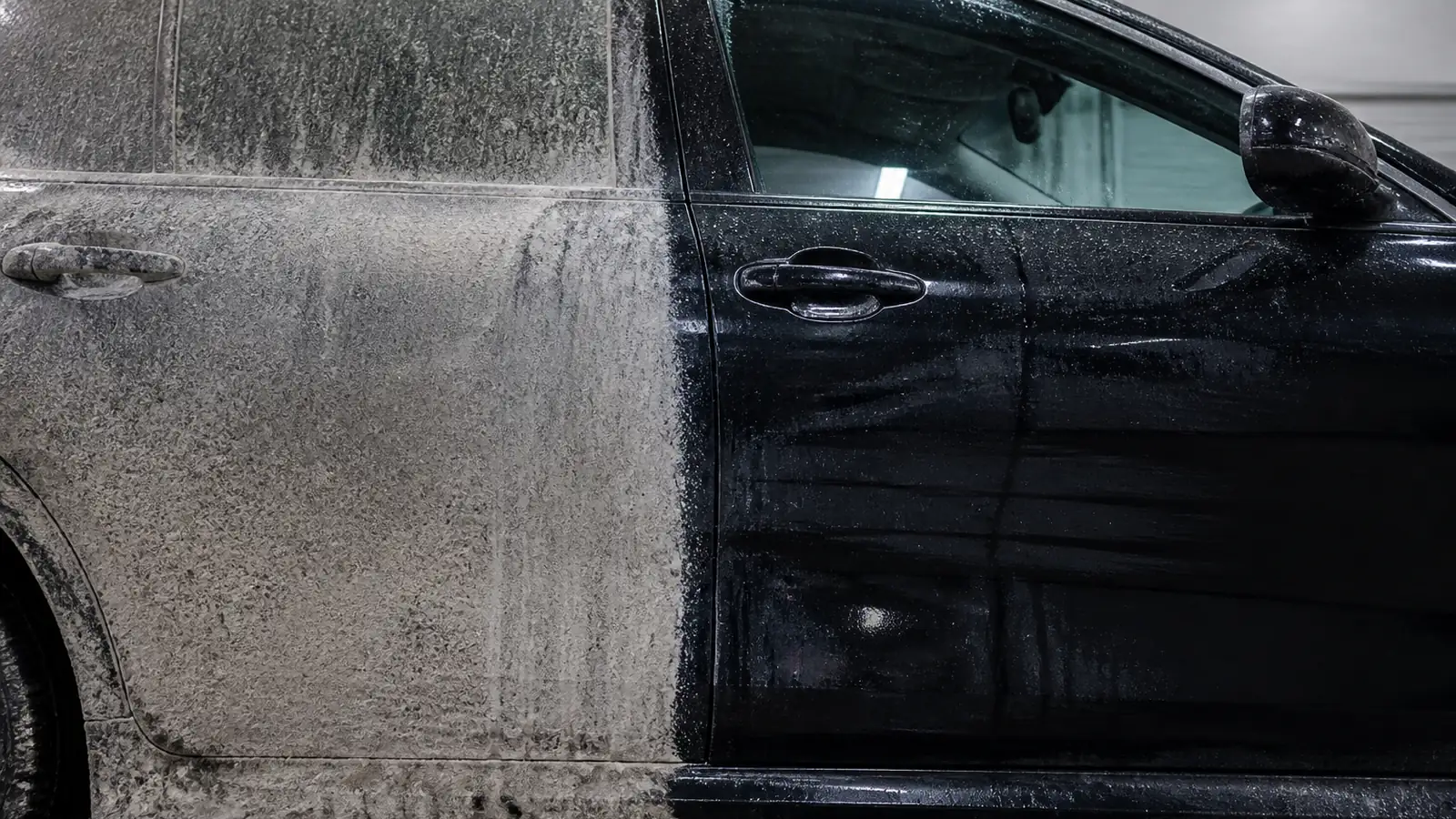
Why “once a week” is a bad answer
The question of frequency is usually answered with a number, which is convenient but wrong. The clear coat does not care how many days have passed. What matters to it is what is sitting on it and for how long.
The same car in June in a quiet residential area can happily stand for two weeks, while in November, after the first road salting, it becomes a problem in three days. It is not about dirt as such: dirt is unattractive but harmless. What is dangerous is whatever is chemically active.
So the right answer sounds like this: a scheduled wash for the season plus an immediate response to whatever eats into the clear coat.
Winter: more often, and it is not about looks
In winter you do not wash the car to make it look good. Road de-icers are salts, and they work as long as they sit there: they eat into the clear coat where it is chipped, reach the metal, and pack into the wheel arches, the sills and the underbody, where they stay for weeks.
A reasonable guide is once every seven to ten days, and after every heavy road salting it is better not to wait. Washing in frost is possible and necessary if the bay is heated: then the water does not set on the body while you are still washing. That is exactly why the bays in the GEIZER network are warm.
Two winter items you must not skip. The first is the underbody wash: that is where the road salt collects most and is seen least. The second is to blow out the mirrors, the door openings, the locks and the sills after the wash and open and close the doors a few times so the water leaves the seals. Otherwise a door will not open in the morning. In detail in the article about washing in winter.
The film keeps the salt slush from gripping the clear coat, so the next round of dirt comes off more easily. On how it works, see a separate article.
Summer and spring: less often on schedule, but with exceptions
In summer a scheduled wash is needed less often — once every two weeks is quite enough for ordinary city driving. But there are four things that do not wait for a scheduled visit.
Bird droppings. The most aggressive thing that lands on a car in warm weather. It is acidic, and in the sun it eats into the clear coat within hours, leaving a matt patch that can then only be polished out. Wash it off immediately.
Insects. The same story, only slower. Dried remains on the grille and the bonnet are hard to wash off later and often risky for the clear coat.
Tree sap and buds. In spring, if you park under trees. Hardened sap can no longer be removed by washing.
Pollen and poplar fluff. They do not eat into anything, but they clog the air intake and the radiator — here the issue is cooling rather than the clear coat.
A word about spring: once the snow is gone, all the winter chemistry stays on the roads as dust. It makes sense to make the first spring wash a full one, with the underbody.
Is frequent washing harmful
A myth that has been around since the nineties: “washing often is bad, the paint wears off”.
A clear coat is worn away not by water and not by chemistry but by mechanical action — by brushes on a dirty body, by cloths, by the sand dragged across the clear coat. That is exactly why touchless washing appeared: it removes dirt with chemistry and pressure, touching nothing.
What can genuinely do harm when you wash often is a broken process, not the frequency itself: alkali at too high a concentration, a brush on a half-washed car, wiping with a cloth every time, washing in blazing sun. Remove those and you can wash every other day.
The other side is also true: washing rarely does more harm than washing often. Road salt that has sat on the clear coat all winter does more damage than fifty careful touchless washes. The habit of washing often is also the demand the whole format rests on: how money is made from it is covered on the page the self-service car wash franchise.
Frequently asked questions
How often should you wash a car in winter?
A reasonable guide is once every seven to ten days, and after a heavy road salting it is better not to wait. In winter you wash not for looks: the salts keep working as long as they sit on the body, they eat into the clear coat where it is chipped and they build up in the wheel arches and under the floor. The underbody wash is not worth skipping in winter.
How often should you wash a car in summer?
For ordinary city driving once every two weeks is enough. But some things do not wait for a scheduled visit: bird droppings and insect remains are acidic and in the sun they eat into the clear coat within hours. Wash them off straight away, without waiting for the next scheduled wash.
Is it bad to wash a car often?
No, provided the wash is touchless and the process is followed. A clear coat is worn away by mechanical action — brushes on a dirty body, cloths and sand — not by water and chemistry. Harm can come from too high an alkali concentration, a brush on a half-washed car and wiping with a cloth, but that is a question of technique, not of frequency.
What has to be washed off a car at once rather than at the next wash?
Bird droppings, insect remains and tree sap. The first two are acidic and in the sun leave a matt patch within hours — which then has to be polished out. Sap hardens and cannot be washed off at all.
Can you wash a car in freezing weather?
You can, if the bay is heated: then the water does not set on the body while you are still washing. Afterwards blow out the mirrors, the door openings, the locks and the sills, and open and close the doors a few times so the water leaves the seals — otherwise a door will be frozen shut in the morning.