

What a franchise agreement means in law
The Russian Civil Code does not use the word franchise. What is commonly called a franchise agreement is legally a commercial concession agreement, covered by Chapter 54. One party, the rights holder or franchisor, grants the other, the user or franchisee, the right to use a set of rights in business: a trademark, experience and technology. The user pays remuneration.
The law gives three points worth knowing before your first meeting with a franchisor.
- Both parties must be businesses. Commercial organizations and individual entrepreneurs enter into the agreement. An individual must first register as an individual entrepreneur (IP) or a limited liability company (OOO); how to choose the legal form and tax regime is explained in the article Car wash taxes and registration.
- In writing only. The law treats an agreement without written form as void. Verbal arrangements made at a meeting have no legal effect until included in the text.
- Registration with Rospatent. The grant of rights under the agreement is registered with Rospatent. Without registration, the law treats the trademark usage right as not having been granted, even if money has already been paid.
Read in this order: first establish whether the franchisor owns what it is offering, then examine the terms.
This is an overview for entrepreneurs, not legal advice. Laws and practice change, and wording matters. Before signing, show the text to a lawyer experienced in commercial concession agreements.
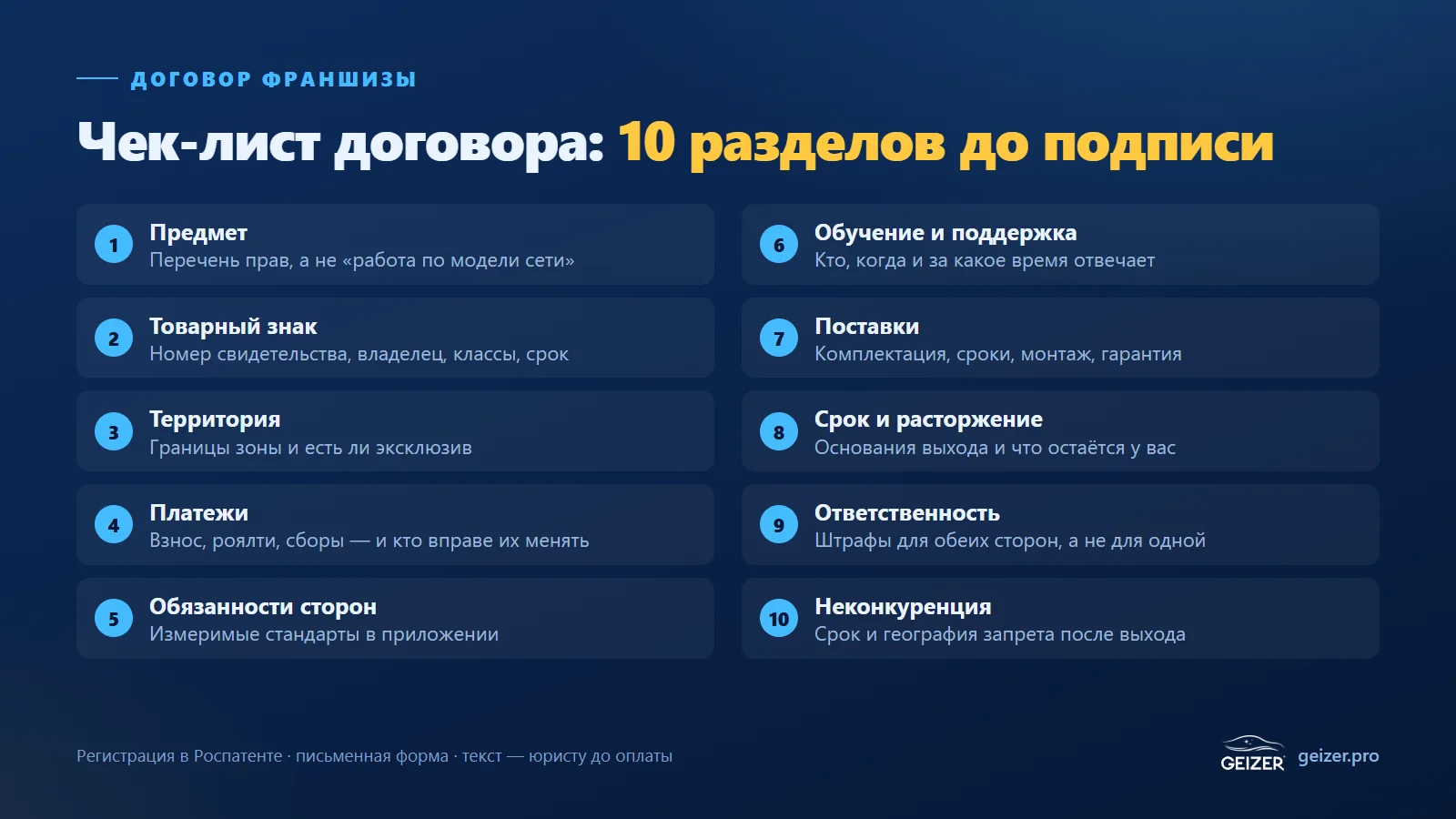
Subject matter and trademark
Subject matter. This section defines exactly what you receive. Good wording lists specific rights: the trademark and certificate number, commercial designation, know-how and software. A right to operate under the network model without a list secures nothing and leaves no clear subject for a later dispute.
Trademark. Without a registered trademark, a commercial concession agreement loses its purpose: there is nothing to transfer. Check three details:
- the certificate number and registered classes; your business activity must fall within them;
- the trademark owner; it should be the company signing the agreement, or the text must explain its authority;
- the trademark's expiry date; if it expires before the agreement, ask whether it will be renewed.
If the trademark right ends without replacement, the law also ends the agreement. The trademark is therefore the basis of the arrangement, not a formality.
Territory and payments
Territory. Look for boundaries in the contract, not the presentation: city, district, radius or address. Separately check exclusivity, meaning a promise not to open other network sites there. There may be no exclusivity; what matters is that spoken promises match the text. For car wash-specific territory questions, see How to choose a car wash franchise.
Payments. The law allows any remuneration structure: an upfront fee, fixed payments, a revenue percentage or supply markups. Put every payment to the network from the agreement into a single table:
- initial franchise fee: amount, deadline and whether refunded if the site does not open;
- royalties: rate, calculation base such as revenue, profit or a fixed sum, and when accrual begins;
- marketing fees and other recurring payments;
- mandatory purchases from the network or its suppliers: prices and who changes them;
- whether the franchisor can raise rates unilaterally and how you are notified.
The last point is often hidden in general clauses. If rates can change without your agreement, all payback calculations are conditional.
Parties' duties, training and supplies
Franchisor's duties. By law, the rights holder supplies technical and commercial documentation and instructs the user. Everything else depends on the written terms. Check specifics: which documents are provided, who trains you and when, how post-launch support works, who answers questions and within what time.
Franchisee's duties. These usually cover quality standards, site appearance, reporting and access for inspectors. Check whether they are measurable. Comply with network standards without an annex containing those standards lets the franchisor allege a breach at any time.
Supplies and equipment. If the business relies on equipment or consumables, establish what is supplied, its configuration and deadline, who installs it, the warranty and who repairs it afterwards. These terms are often in separate supply and maintenance agreements rather than the concession agreement; read them together as one transaction. We compare a franchise with buying equipment alone in franchise or equipment.
Liability. Read penalties for both parties. If only the franchisee faces sanctions while the franchisor has no liability for late supply, the imbalance is clear. Also, the law allows the rights holder to bear liability to customers for the user's product quality, so contractual quality control is normal.
Duration, termination and non-compete restrictions
Duration. The agreement may be fixed-term or indefinite. Either party may end an indefinite agreement by giving at least six months' notice unless a longer period is specified. Compare the agreement's duration with your project's payback period: a one-year contract for an investment that takes longer to recover requires discussion.
Termination. Find each party's grounds for early termination and the aftermath: removal of signage, ownership of equipment and the customer database, any buyout or return obligations, and exit penalties.
Non-compete restrictions. The agreement may restrict franchisees from working in the same field or with competitors and require agreement on a site's location. Some restrictions are permitted, while others may be invalid under competition rules. The main concern is the duration and geography after exit: a nationwide ban lasting years effectively closes the sector to you.
Warning signs in the contract
We cover general signs of a doubtful franchise, such as income promises, pressure to hurry and missing site addresses, in our article Choosing worthwhile franchises in 2026. Here are signs visible in the contract itself:
- a license, agency or services agreement is offered instead of a commercial concession agreement, and Rospatent registration is said to be unnecessary;
- the subject-matter section lacks a trademark certificate number;
- the trademark belongs to another company or an individual, without an explanation of the franchisor's rights;
- the franchisor may change payment rates without the franchisee's consent;
- standards and mandatory-purchase price lists will be provided later and are not attached;
- liability and penalties are specified for one party only;
- the franchisor's termination grounds are vague, such as breaching network standards;
- you may only read the text in the office and cannot take it away for a lawyer to review.
How to check a franchisor before buying
The checks take a couple of evenings, and almost everything is available from public sources.
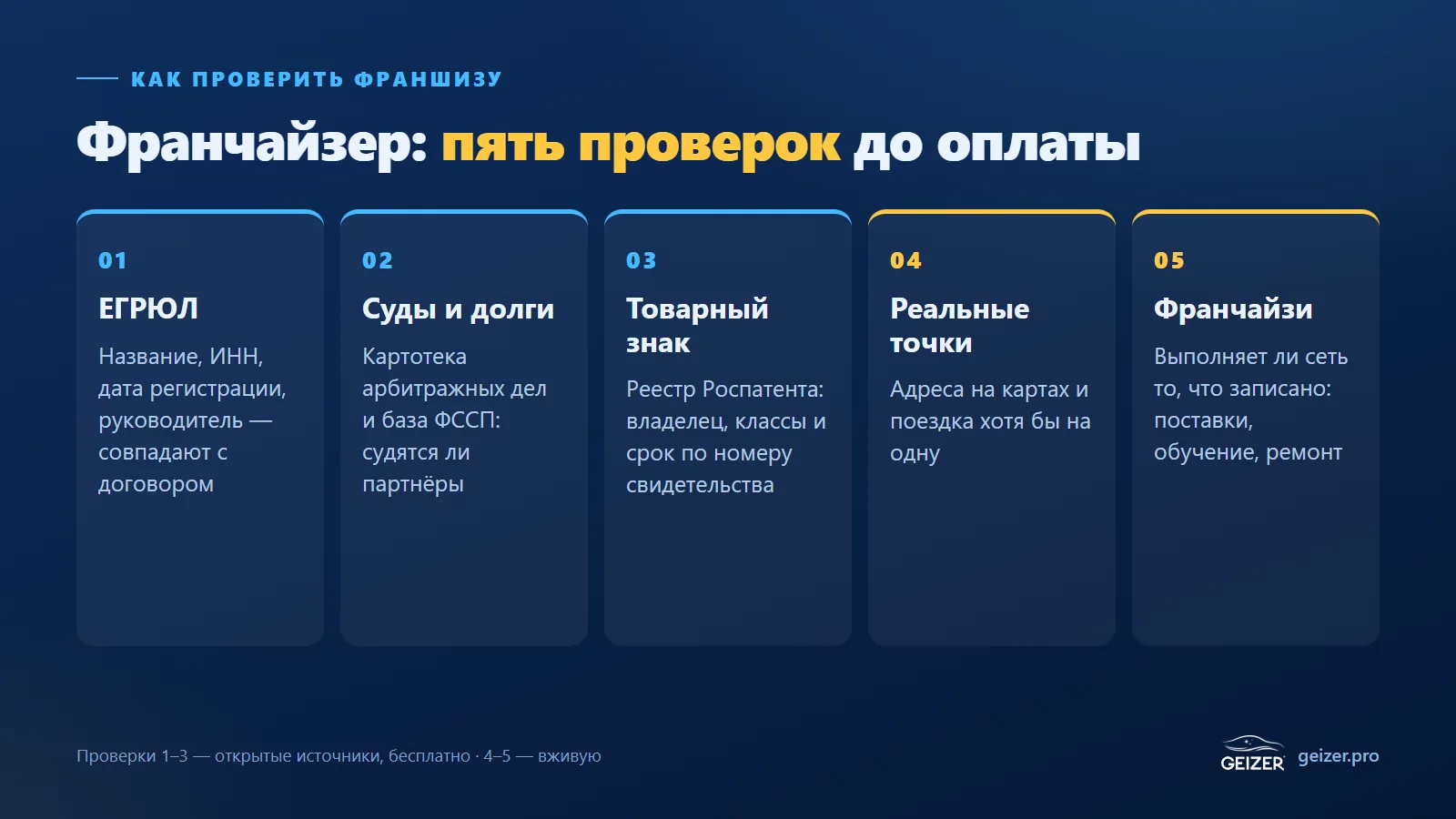
- Company register. An extract is free on the Federal Tax Service website. Compare the name, tax ID, registration date, address and director with the agreement. A company formed a couple of months ago claiming a ten-year network history raises questions.
- Litigation and debts. The arbitration case register and Federal Bailiff Service enforcement database show whether partners and suppliers are suing the franchisor.
- Trademark. Rospatent's public FIPS registers show the rights holder, classes and expiry date using the certificate number. This number must match the agreement.
- Operating sites. Get an address list, check on maps that the sites operate under the brand and visit at least one.
- Talking to a franchisee. Ask an existing partner whether the network fulfills its written supply deadlines, training, support and repair obligations. Ask whether a dispute occurred and how it was resolved.
Also ask the franchisor direct questions in writing so answers can be compared with the text: where and when the agreement is registered, whether a sample is available before payment, which annexes exist, what happens to the fee if the site does not open, and how many partners left and why.
How GEIZER handles this
We open self-service washes through franchising and manufacture BRIZ equipment ourselves. Here is how these sections work with us, using only what is published on the franchise page.
- Four agreements: supply, installation, commercial concession and maintenance. Supply contents and terms are written down, not merely discussed.
- The GEIZER trademark is registered under certificate No. 785672 and valid until 2030. The number can be checked in the register.
- Payments: an initial franchise fee of 0 ₽ and royalties of 5% of an operating wash's revenue; nothing is payable before the wash opens. The rate is fixed in the agreement.
- Supply: bay equipment including delivery, installation, commissioning and training starts at 450,000 ₽. The site is assessed separately after inspection.
- Training and service: equipment and CRM training, a 12-month equipment warranty, spare parts stock and an engineer's visit; procedures and response times are in the maintenance agreement.
This list is not a reason to sign without reading. Request all our agreements and check the same ten sections you would with any franchisor. Before signing, visit an operating network wash; addresses are on the Network cities.
Frequently asked questions
What is the legal name for a franchise agreement?
The Russian Civil Code calls it a commercial concession agreement in Chapter 54. It does not use the word franchise. The agreement is made in writing between companies or individual entrepreneurs, and the grant of rights is registered with Rospatent.
Does a franchise agreement need Rospatent registration?
Yes. The grant of rights under a commercial concession agreement requires state registration with Rospatent. Without it, the law treats the usage right as not having been granted. Ask who files the documents and by when, and have a lawyer check this.
Can an individual sign a franchise agreement?
No. Only commercial organizations and individual entrepreneurs can be parties to a commercial concession agreement. First register as an individual entrepreneur (IP) or a limited liability company (OOO), then sign the agreement.
Which franchise agreement terms should I check first?
The subject matter and trademark number, territory, all payments and the franchisor's right to change them, training and supply duties, duration, termination grounds and any non-compete restriction after leaving.
How do I check a franchise before buying?
Get a company-register extract from the Russian Federal Tax Service website, check the arbitration case register and Federal Bailiff Service database, and find the trademark in Rospatent's register using its certificate number. Check operating-site addresses on maps, visit at least one and talk to an existing franchisee.
Can a franchise agreement be terminated early?
It depends on the wording. Either party may end an indefinite agreement with six months' notice unless the agreement requires longer. For a fixed-term agreement, the grounds and consequences of early exit are in the contract itself and must be read before signing.
Is a ban on working in the same sector after leaving legal?
The law permits restrictive terms in concession agreements, but some may be invalid under competition rules. A lawyer should assess the specific wording, duration and geographical scope.
Do I need a lawyer to sign a franchise agreement?
Preferably. This article helps you know what to look for but does not replace legal review: exact wording and annexes matter. A lawyer's review usually costs less than a dispute after signing.