
Why comparing entry fees shows you nothing
The first thing anyone with five offers in hand does is write the entry fees into a column. It is a clear and almost useless table: the fee is a small part of the investment in a site and says nothing about how the wash will be working in its third year.
The fee in itself is not a sign of a bad franchise. It is fair if there is work behind it: location analysis, the design, training, opening marketing. A zero fee is equally fair if the franchisor earns on something else and says plainly what that is.
Whoever earns only at the entrance loses interest in your site the moment you pay.
Who you are dealing with: a factory or a franchise seller
This is the first question, and it determines almost everything else. A company either makes the equipment itself, or buys it from someone and resells it to you with a markup, or has nothing to do with equipment at all and sells only a brand and a set of manuals.
The difference shows up not at the deal but afterwards. A manufacturer learns about the weak points of its stations before its customers do — on its own network — and fixes them before complaints pile up. A middleman learns about the problem from you and passes it further down the chain.
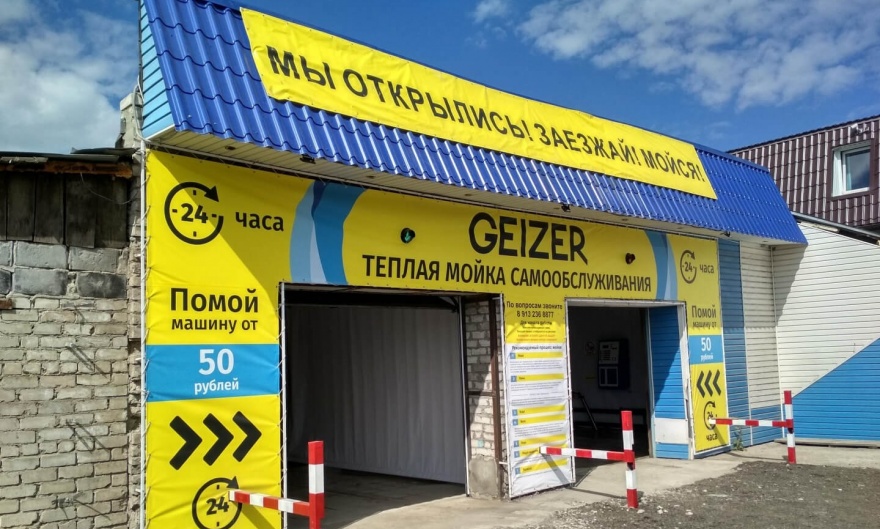
GEIZER is of the first type: BRIZ equipment is made in Barnaul, and the company's own network runs on it — 199 car washes and more than 400 bays in 69 cities across three countries. That is worth checking not by what is said but by the address of the plant and by the working sites.
What the price is made of and what it leaves out
A full opening budget has four items, and the confusion usually arises because different companies call different parts of it “the price of the franchise”.
Only the first item can be costed exactly. The other three depend on the site and differ several times over: a ready building with water and power already connected costs incomparably less than an empty plot. That is why any full budget figure named before your site has been inspected is a market average, not yours.
A practical move: ask for the figure to be broken down into these four lines, and ask separately what it does not include. What is most often left out is commissioning, training, the sign and the electricity connection.
The royalty: what it is calculated on and when it starts
Three parameters matter here, and all three must be seen in the contract rather than in a presentation. What it is calculated on — revenue or profit. When the payments start — on signing or with the first revenue of a working wash. And whether there is a minimum payment you will owe even when the site stands idle.
A minimum fixed payment is the nastiest of the three. It turns the royalty from a share in a common result into rent for a brand, which you pay whether the site earns anything or not.
Our royalty is 5% of the revenue of a wash that is already running: while there is no site and no revenue, there is nothing to pay. How this is counted in the model — in a separate article.
Equipment: whose it is, where it is made, where the parts come from
A self-service wash runs around the clock and under load, so what matters is not the pressure on the datasheet but the service life of the units and the availability of spare parts. Three questions worth asking in exactly these words:
- Where the equipment is made and for how long. Ask for the addresses of sites in your climate zone and the year they opened — that can be checked in an evening and says more than the ranges on a datasheet.
- How long a spare part takes to reach your city. Do not ask whether there is a warehouse; ask about the route: where exactly a part travels from to reach your city and how long that took the last time.
- What the warranty covers and what happens after it. Post-warranty service should be described before the deal, not discussed at the moment of a breakdown.
For regions with a real winter there is a fourth: is the equipment designed for frost. BRIZ stations work in a range from −35 to +35 °C, and that is not a figure from a datasheet — the network has sites in Surgut, Kogalym and Novy Urengoy.
Service: who comes out if a station stops on a Saturday
The answer “yes, we have a service department” means nothing until a time is named. Ask in hours and days: how long the first line takes to respond, how long an engineer takes to arrive, what happens if they do not arrive in time. And separately: which of this is written into the maintenance contract and which was only said out loud.
So do not ask whether there is a service department; ask for specifics: exactly who comes out, from where, what is fixed in the maintenance contract and what happens if the engineer does not arrive in time. Verbal promises of round-the-clock support are worth exactly as much as the contract says about them.
Ask to see the section itself, not a retelling of it.
Territory: what exactly is protected for you
The phrase “the city is reserved for you” can mean anything. Ask for the boundaries: the whole city, a district, a radius in kilometres — and for how long. Ask separately what happens when the network expands: will you have the first option on a second site, or may the franchisor sell the neighbouring plot to another partner?
A good sign is being told plainly that a city is taken, instead of being sold a spot right next to a working partner. A bad one is a vague answer to a question about boundaries.
What to ask to be shown before signing
Four things, each of which can be checked in a single day:
- A working site. Find the nearest site in the network and wash a car yourself. The pressure, the quality of the foam, the speed of the terminal and how easy the interface is are all visible within ten minutes — and they tell you more than any presentation.
- Reviews on the maps. Customers write about exactly what breaks: whether the time was enough, whether there was pressure, whether the vacuum worked.
- A working partner. A conversation without the franchisor present is the most honest check there is.
- The whole contract. Before any payment, with the sections on territory, royalties and termination.
A refusal to show you a site, a partner or the contract is an answer in itself, and it saves you a lot of deliberation.
Red flags
- They name a specific revenue before they have seen your plot
- They promise a payback period as a single number, with no scenarios and no range
- They cannot say where the equipment is made
- They will not show the contract before payment
- They cost your budget on market averages
- They will not say how many sites in the network closed over the past year
The last point is the most telling. Everyone has openings; closures are talked about reluctantly — and it is closures that show what happens to a site once the opening marketing runs out.
Frequently asked questions
How do you choose a self-service car wash franchise?
Compare eight things rather than the size of the entry fee: who makes the equipment, what the full budget consists of, what the royalty is calculated on and when it starts, whose equipment is supplied and where the spare parts come from, how the service works, what exactly is protected in terms of territory, what they are willing to show at a working site, and what the contract says. An offer that passes all eight and costs more at the entrance almost never turns out to cost more over three years.
Which is better: a franchise with an entry fee or without one?
Neither option is worse in itself. The fee is a payment for entry, and it is fair if there is work behind it: location analysis, the design, training, opening marketing. A zero fee is fair if the franchisor earns on something else and says what that is. The bad sign is not the number but a refusal to explain where the franchisor's income comes from: whoever earns only at the entrance loses interest in you the moment you pay.
How much does a self-service car wash franchise cost?
There is no single price, and any figure named before your site has been inspected is a market average, not yours. The budget has four items: the equipment, the site, utilities with permits, and working capital for the first months. Only the first can be costed exactly; the other three depend on the site and differ several times over, so a meaningful answer appears only after a conversation about a specific city and a specific plot.
What questions should you ask a franchisor before signing?
Who makes the equipment and whether the company has its own production. What is included in the price named and what is paid for separately. What the royalty is calculated on and when the payments start. How long a spare part takes to reach your city and who will come out if a station stops on a weekend. What exactly is protected in terms of territory and how that is written into the contract. How many sites opened over the past year and how many closed. The answer to the last question says more than any presentation.
How do you check a car wash franchise before buying?
Go to a working site in the network and wash a car yourself: the pressure, the quality of the foam, the speed of the terminal and how easy the interface is are all visible within ten minutes. Read customer reviews on the maps — people write about what breaks. Find a working partner and talk to them without the franchisor present. Ask for the full contract before paying anything and read the sections on territory, royalties and termination. A refusal to show you a site, a partner or the contract is an answer in itself.
How we answer these questions →