

How robotic and self-service washes differ
Both formats operate without wash attendants, so they are often grouped together. But they work differently and are two different businesses for the owner.
- Robotic wash. The driver enters the bay, selects a programme and pays. An automatic machine, either a rollover moving over the car or a spray frame, then washes it. Robots may be touchless or brush-based. The customer stays in the car or waits nearby; the process takes a few minutes.
- Self-service wash. The driver washes the car: the bay has a high-pressure gun and settings such as water, active foam, wax and reverse-osmosis rinse. They pay for the bay's operating time and decide how long and how to wash.
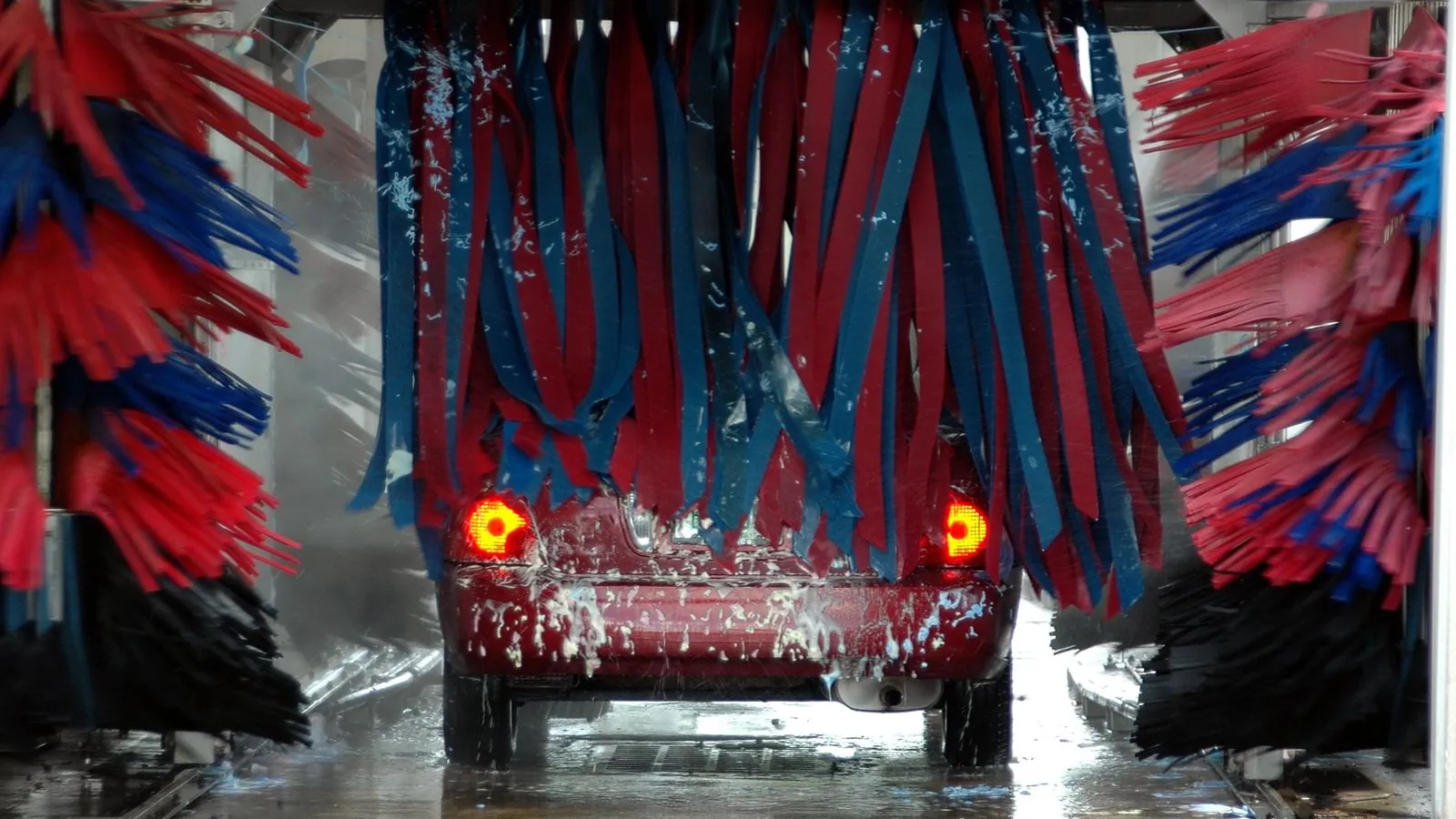
This creates the main business difference. A robot sells a finished result at a fixed price. A self-service bay sells minutes of equipment use, with the customer producing the result. It affects everything: transaction value, investment, reliability and losses when something breaks.
The cost of opening a robotic wash and a self-service bay
Few robotic-wash figures are public and verifiable: manufacturers quote different amounts and define “turnkey” differently. We therefore cite one publication and clearly identify its author.
In July 2026, T—J magazine published a robotic-wash market review written by the head of a company that manufactures these washes. His estimate for launching one operational bay turnkey was 6.5–8 million ₽, including Russian contour-following equipment from 4.07 million ₽, bay construction or conversion at 1.5–3 million ₽, and water treatment at about 600 thousand. He also writes that dealers buy Chinese packages for 1.5–2 million ₽ and sell them as a “franchise” for 5–6 million. This is a market participant's opinion rather than an independent valuation, but it indicates the scale of costs.
For a self-service bay, we can quote our own figures. We manufacture BRIZ equipment in Barnaul: the basic package costs 430 000 ₽ per bay. Under the franchise, a bay starts at 450 000 ₽ including delivery, installation, commissioning and training. Land or rent, the structure, canopies and gates, utility connections and paperwork are separate. The full budget is explained in the article how much it costs to open a self-service car wash.
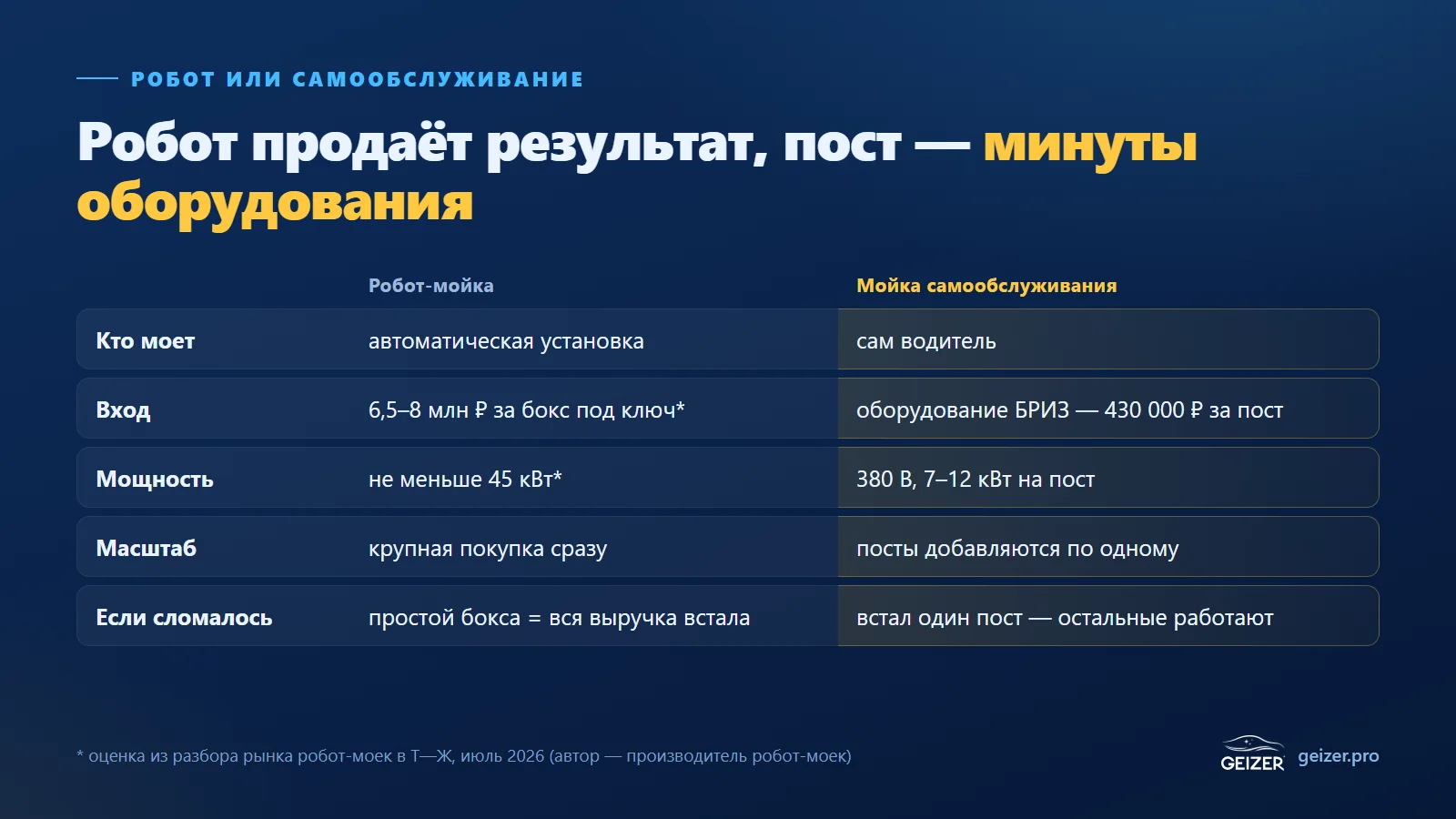
The difference is not only the amount but the investment step. A robot is a large purchase for one bay upfront. Self-service can start with one or two bays, adding more when traffic is proven.
Land, electricity and water
Before comparing income, check whether your land is suitable at all. Here the formats differ even more than they do in price.
- Electricity. The same T—J review estimates at least 45 kW for a robotic wash. A self-service bay needs three-phase 380 V and 7–12 kW of allocated capacity. Where power is limited, this often determines the choice.
- Area. A self-service bay needs about 39 m² for the structure, approximately 30 m² for parking and manoeuvring, and at least 4 m² for the technical area. A robotic wash needs a structure for the machine and space for an entrance queue.
- Water. Both formats need water supply, treatment and wastewater drainage. Without water treatment, white streaks remain on cars, a problem for both robots and self-service bays.
A detailed site checklist is in the article premises requirements for a self-service car wash. A landlord's promise to “provide 380 V” is not the same as having the technical connection conditions in hand.
Car traffic and average transaction value
A robot charges more per wash because it does the work for the customer. The same T—J review gives an average robotic-wash transaction of about 795 ₽ in a large city and throughput of 50–60 cars per day per bay. These are figures for a good location in a large city, not a national average.
Self-service usually has a lower transaction value: customers wash themselves and pay only for time. However, several bays can be installed on one site and operate simultaneously. A bay's actual income depends on road traffic, the price per minute and the season; we explain this calculation in the article how much a car wash earns.
Customers also differ. Robots appeal to people who do not want to leave the car and will pay for that convenience. Self-service appeals to those who want a quick, inexpensive wash done their own way, for example thoroughly cleaning wheel arches and sills in winter. There are many such drivers, especially in small and medium-sized cities and in winter, when arches and sills need manual cleaning. They provide a self-service wash with steady traffic.
Expenses and maintenance
Both formats have similar types of variable costs: water and wastewater, electricity and chemicals. The T—J author estimates these at 100–135 ₽ per robotic wash. At a self-service bay, consumption depends on how long customers use the bay and which settings they select.
The main difference is maintenance. A robot is complex machinery with drives, sensors and software. The same author estimates that a bay's seasonal downtime costs the owner 50–100 thousand roubles in daily revenue; repairs often have to wait for a manufacturer or dealer specialist. Self-service bays are simpler, and when there are several bays, one breakdown does not stop the entire wash. How we service our bays is explained in the article car wash maintenance.
Robotic car wash risks
Before investing millions in a robot, learn its weak points: better before buying than during the first year of operation.
- Robotic wash: dependence on the supplier. Parts, software and servicing all depend on the manufacturer. If the model is discontinued or the dealer leaves the market, maintaining the machine becomes difficult.
- Robotic wash: one bay, one point of failure. When the robot stops, all revenue stops.
- Robotic wash: cleaning complex shapes. An automatic machine cleans bumpers, sills and number-plate recesses less thoroughly than a person with a pressure gun. Some customers therefore return to self-service.
- Robotic wash: an expensive location mistake. If traffic is lower than expected, millions have already gone into one bay and the project cannot be scaled down.
A self-service wash's main risk is location, as it is for any wash. But the cost of getting it wrong differs: you can start with one or two bays and add more when traffic is proven.
Why self-service is more profitable for most owners
Taken together, the advantages of self-service bays form a straightforward list.
- Entry cost several times lower. BRIZ equipment costs 430 000 ₽ per bay versus millions of roubles for a robotic bay.
- You can start small. One or two bays at launch, more when traffic is proven. A robot requires the full amount upfront.
- Ordinary power capacity is enough. 7–12 kW per bay instead of 45 kW or more makes many more sites suitable.
- A breakdown does not stop the business. If one bay stops, the others keep earning.
- Simpler maintenance. We manufacture the equipment ourselves in Barnaul; parts and service come from the manufacturer, not a reseller.
- More thorough rinsing. Customers clean arches, sills and bumpers as thoroughly as they need, which is why they come to self-service.
A robot suits someone with millions available for one bay, an expensive high-traffic location and a willingness to depend on one machine. For everyone else, starting with self-service bays is more profitable.
How to calculate payback using your own figures
The T—J review's author calls 12–18 months a realistic payback period for a robotic wash and explicitly describes promises of “less than a year” as marketing. Self-service payback also depends on location, and we do not promise a universal figure. The most reliable way to assess value is to calculate a self-service wash for your own site.
- The full entry cost. Not only equipment, but the structure, utility connections, water treatment and paperwork.
- Traffic on your road. How many cars pass and how many are washed in your area.
- Transaction value and utilisation in different seasons. The best and worst months, rather than the average.
- Fixed expenses. Rent or land tax, maintenance, communications, cleaning and royalties if you operate under a franchise.
- The cost of downtime. How much you lose per day if equipment stops, and how quickly it can be repaired.
For a self-service wash, you can make this calculation with the calculator: set the bays, traffic and transaction value. This is a preliminary estimate, not an income promise. If you already have land, send the address: we can advise how many bays fit and whether power capacity is sufficient.
Frequently asked questions
Which is more profitable: a robotic or self-service car wash?
For most owners, self-service. A robot earns a higher transaction value but requires millions of roubles in one bay and at least 45 kW; a breakdown stops all revenue. A self-service bay costs several times less, bays can be added one at a time, and one bay breaking down does not stop the whole wash.
How much does a turnkey robotic car wash cost to open?
Few figures are publicly available and verifiable. A market review in T—J magazine in July 2026, written by the head of a robotic-wash manufacturer, estimated a turnkey launch of one bay at 6.5–8 million ₽.
How many cars does a robotic wash clean per day?
The same T—J author estimates 50–60 cars per day per bay, with an average transaction of about 795 ₽ in a large city. These figures represent a good location, not a national average.
How much does a self-service wash bay cost?
The basic GEIZER equipment package costs 430 000 ₽ per bay. Under the franchise, prices start at 450 000 ₽ per bay including delivery, installation, commissioning and training. Land, the bay structure and utility connections are calculated separately.
What power supply do robotic and self-service wash bays need?
The T—J review estimates that a robotic wash needs at least 45 kW. A self-service bay needs three-phase 380 V and 7–12 kW of allocated capacity per bay.
What are the risks of a robotic car wash?
Dependence on the manufacturer for parts and servicing, one bay as a single point of failure, poorer cleaning of difficult areas such as bumpers, sills and number-plate recesses, and an expensive mistake if the location underperforms.
Why does GEIZER make self-service washes rather than robots?
Because the format is more accessible to owners and more reliable in operation: a lower entry cost, growth one bay at a time, ordinary site power requirements and a wash that does not stop because one machine fails.