
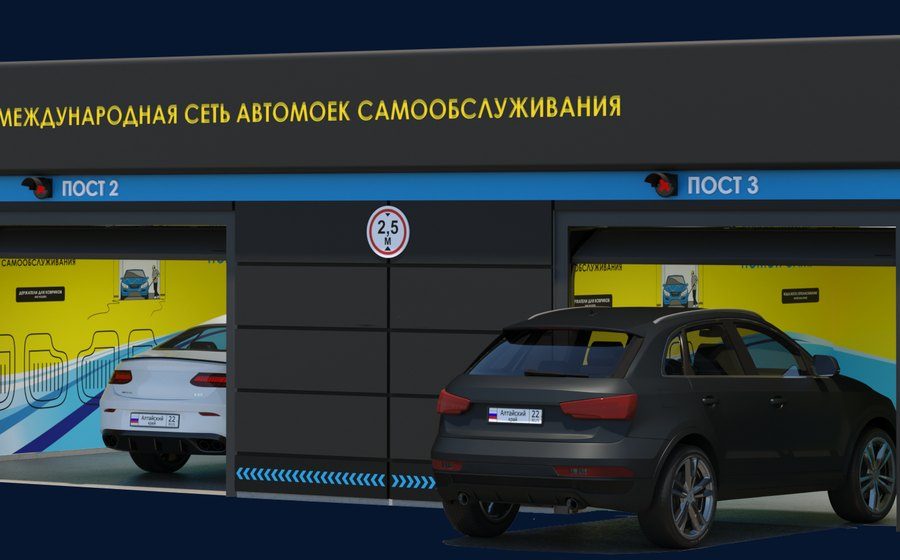
Evaluate the site as a system
A suitable floor area doesn't guarantee a convenient wash. A car needs to drive in, park, get washed, and drive out without getting in the way of the next one. If the entrance is narrow or the turning radius is awkward, throughput will be limited by logistics, not by the number of bays.
Evaluate the site as a whole: access from the road, space for a queue, equipment placement, access to utilities, and the ability to service one bay without shutting down the others.
Basic parameters per bay
These figures are given per bay and scale proportionally. For two or three bays, the technical area doesn't simply double — some equipment is shared, so it's better to run the exact calculation for your specific project.
Electricity is the most common problem
Three-phase power and a dedicated capacity are needed from the start. Connecting or increasing capacity takes both time and money, and both of those depend on the grid operator in your city, not on you.
A landlord's promise of "we'll get you 380V" isn't the same as having the technical specifications in hand.
Water supply and drainage
A stable volume and pressure are required. A well, a centralized water supply, or delivery — each option has its own economics, and you need to calculate them in advance.
Drainage is governed by wastewater treatment requirements. A septic system or a water recycling system is a mandatory part of the project, not something you can add later.
Climate: what matters in Siberia and the Urals
The GEIZER network operates in Barnaul, Novosibirsk, Krasnoyarsk, Kemerovo, Surgut, Kogalym, and Novy Urengoy. In these regions, a heated bay isn't an option — it's a condition for year-round operation.
When choosing premises, check: the possibility of insulation, heating for the technical area, pipe freeze protection, and heating for the pad in front of the doors. In winter, it's exactly these small details that decide whether the site is running or standing idle.
What to check before signing
- Technical specifications for electricity — in writing, not just verbally
- Water source, its hardness, and the stability of the supply
- Drainage approval and space for the septic tank
- Entry width and turning radius for a passenger car
- Visibility from the road and the possibility of placing signage
- Permitted land use and the designated purpose of the premises
Frequently asked questions
How much floor area does a self-service car wash need?
Per bay: about 39 m² for the bay itself, plus around 30 m² for parking and manoeuvring, and from 4 m² for the technical area. The figures are per bay and grow proportionally, but the technical area for two or three bays does not double: some of the equipment is shared.
How much electrical power does one bay need?
Three phases, 380 V and 7–12 kW of dedicated capacity per bay. The capacity is needed from day one: connecting it or increasing it costs time and money, and both depend on the grid operator in your city. The technical specification should be a document in your hands before you sign the lease, not the landlord's promise to "sort out the 380".
How much water does a self-service car wash bay use?
A steady supply of about 14 litres per minute per bay at working pressure is required. The source can be a borehole, the mains or delivered water — each option has its own economics, and it has to be calculated before choosing the site, not afterwards.
Is a septic tank mandatory for a self-service car wash?
Wastewater is governed by effluent treatment requirements, so a septic tank of 6 m³ or more, or a water recycling system, is a mandatory part of the project. This is not something to finish after opening: approval of the septic tank location is checked before the lease is signed.