

Franchising explained simply: what you are buying
A franchise is a contract under which one company lets another operate under its brand and business model. The party granting the right is the franchisor; the party receiving it and opening the outlet is the franchisee. In Russia this is called a commercial concession agreement, governed by Chapter 54 of the Civil Code.
You are not buying the outlet itself. You open it yourself, using your own money and your own company or sole proprietorship. You buy a system: a name customers already know, a proven format, suppliers, training, software and support. The franchisor charges for that system, usually in two ways: once upon entry and regularly while you remain in the network. The first payment is the initial franchise fee; the second is royalties.
This leads to a useful rule: every payment to the franchisor is the price of some part of the system. If you cannot identify which part, the payment is either unnecessary or poorly explained.
What an initial franchise fee is
An initial franchise fee is a one-off payment to join the network. The term “paushal” comes from the German pauschal, meaning “as a whole, in one total”. It is one amount paid once, usually at signing or before the launch process begins.
What it covers depends on the franchise. Most often it includes the right to use the brand in an agreed territory, standards and instructions, training and sometimes outlet design and location assistance. Sometimes these are detailed; sometimes there is only one line: “the right to use the trademark”.
The amount says nothing about franchise quality. A large fee may fairly pay for substantial launch work, or it may be the franchisor's main income, after which your success matters less. A small or zero fee may mean income comes from supplies, equipment or royalties. Look beyond the amount at three things:
- Exactly what you receive. A list of work and materials, not vague promises of “support”.
- When you pay. Do not pay before seeing the contract and a calculation for your own location.
- What happens if the outlet never opens. Whether the fee is refunded in full, in part or not at all must be written down.
Royalties explained simply
Royalties are regular payments to the franchisor for continuing to operate in its network. If the initial fee pays for entry, royalties pay for staying. They are usually paid monthly, less often quarterly.
The network should do something every month for royalties, not only at launch. This may include brand and shared advertising work, accounting and sales software, updates, support, consultations, new products and standards. The same test applies: what does the network do for this money in a normal month when everything is running?

An important detail is when royalties begin. Starting on the outlet's first operating day is logical: you have revenue, and the network receives a share. Starting at signing may mean paying for months while the outlet is still under construction and earns nothing. Notice this condition in advance.
Percentage versus fixed royalties: the difference
There are two royalty types, and they behave differently in good and bad months.
- A percentage of revenue. You give the network a share of the outlet's revenue. A weak month means a smaller payment; a strong month means a larger one. The network earns more only when you do, so it benefits from good performance. The drawback is that revenue calculation must be clear and the network needs visibility of it.
- A fixed amount. The payment is the same every month regardless of events. It is easy to budget and barely noticeable in strong months. But it weighs heaviest in weak months, the first months after opening and the off-season: revenue is low but the payment stays the same.
Hybrid arrangements also exist, such as a percentage with a minimum amount. A beginner's key question is what happens in a low-revenue month. With a percentage the answer is clear; with a fixed amount or a minimum, calculate it in advance using your own figures.
Another detail of percentage royalties is the calculation base. The percentage is taken from revenue, all money customers pay, rather than profit. If the contract says otherwise, understand this before signing. We separately explain the effect on a specific outlet's costs and payback in the article franchise economics: royalties, margin and payback, so we will not repeat it here.
When there are no royalties, and why that is not always good
Royalty-free franchises exist and look attractive. But a network still needs an income source to maintain its brand and support. It is usually found in one of these places:
- The price of goods or raw materials. You must buy from the franchisor, whose income is built into the markup. There are formally no royalties, but you pay them with every purchase.
- A large entry fee. The network earns once, at entry. Afterwards its interest in your outlet may weaken significantly.
- Other regular charges. There are no royalties but there is a monthly software fee or advertising-fund contribution.
A fair royalty-free option also exists: buying equipment or technology rather than a franchise and operating under your own name. You then do not receive what the network provides: its brand, shared customer base and network software. This is neither better nor worse, simply a different choice. We discuss when it makes sense in the article franchise or equipment.
What other payments a franchisee may face
The initial fee and royalties are the most visible lines, but not the only ones. Extra costs most often hide in payments mentioned only in passing during a meeting.
- Marketing fund. A regular contribution to shared network advertising, separate from royalties. Ask the amount, the calculation base and how you will know where the money went.
- Software and services. Charges for cash-register software, CRM, the app and the account dashboard. Sometimes they are included in royalties; sometimes they require a separate subscription.
- Mandatory purchases. Raw materials, consumables, packaging, uniforms and signage must come from network suppliers. This is reasonable if prices are specified or at least their adjustment method is clear.
- Training new employees. Initial training is often included in the entry fee; every subsequent session may be charged.
- Renewal and transfer. Charges for renewing an expired contract or transferring the outlet to another owner.
- Penalties. For breaching standards, late reporting or leaving the network early.
Separate costs are paid to others, not the franchisor: rent or land, renovation, utility connections, paperwork, staff, taxes and money for the first operating months. They are absent from the franchise contract but often form the largest part of the budget. A good network helps calculate these before you sign anything.
What to ask the franchisor about payments
To avoid confusion, ask the same set of questions for every payment and request written answers. Verbal promises do not become contract terms.
- What network payments exist? Give the full list, including funds, subscriptions, training and penalties.
- For each: how much, on what basis and starting on which day?
- What does the network do for each payment, specifically and item by item?
- Can rates change during the contract, and if so, how?
- Which purchases are mandatory, from whom and at what prices?
- What happens to the entry fee if the outlet never opens, and what happens when leaving the network?

Compare the answers with the contract. Everything mentioned in the meeting should appear there. A contractual payment that was not disclosed is a reason to ask again; a disclosed payment missing from the contract is a reason to request an addition. Other checks, operating outlets, servicing, city-specific calculations and exit terms, are gathered in the article franchises in 2026: how to distinguish a worthwhile offer from an empty one.
Add up every payment to the network in the first operating year using your own figures: entry fee, royalties, funds, subscriptions and mandatory markups. Ask which of these things you could not do yourself more cheaply. That is the real franchise price.
How this works in the GEIZER franchise
Here is our example, the GEIZER self-service wash network. We manufacture BRIZ equipment ourselves in Barnaul. Below is only what is written in our terms on the franchise page.
- Initial franchise fee: 0 ₽. We charge nothing to join. We earn from equipment and royalties on an operating wash, so taking an entry payment and forgetting the partner is not in our interest.
- Royalties: 5% of revenue. A percentage rather than a fixed amount, calculated on an already operating wash's revenue. Before the site opens and earns revenue, there is nothing to pay. In return, the partner gets the GEIZER brand, CRM and account dashboard, mobile app, support and software updates. The rate is stated before the deal and fixed in the contract.
- Equipment is not an entry markup. The basic package costs 430 000 ₽ per bay, the same as without a franchise. Under the franchise, a bay starts at 450 000 ₽: the difference covers delivery and on-site launch, not the brand. It includes installation, commissioning and training.
- What you pay to others. Land or rent, slab, canopies and gates, water, 380 V electricity and sewerage, signage and lighting, and paperwork. We calculate this part after inspecting your site, before you sign anything.
Our terms do not list software and the app as separate subscriptions: they are included in royalties. If you want to operate independently under your own name, you can buy equipment directly. There are then no royalties, and we supply and service the station. Terms are on the equipment page.
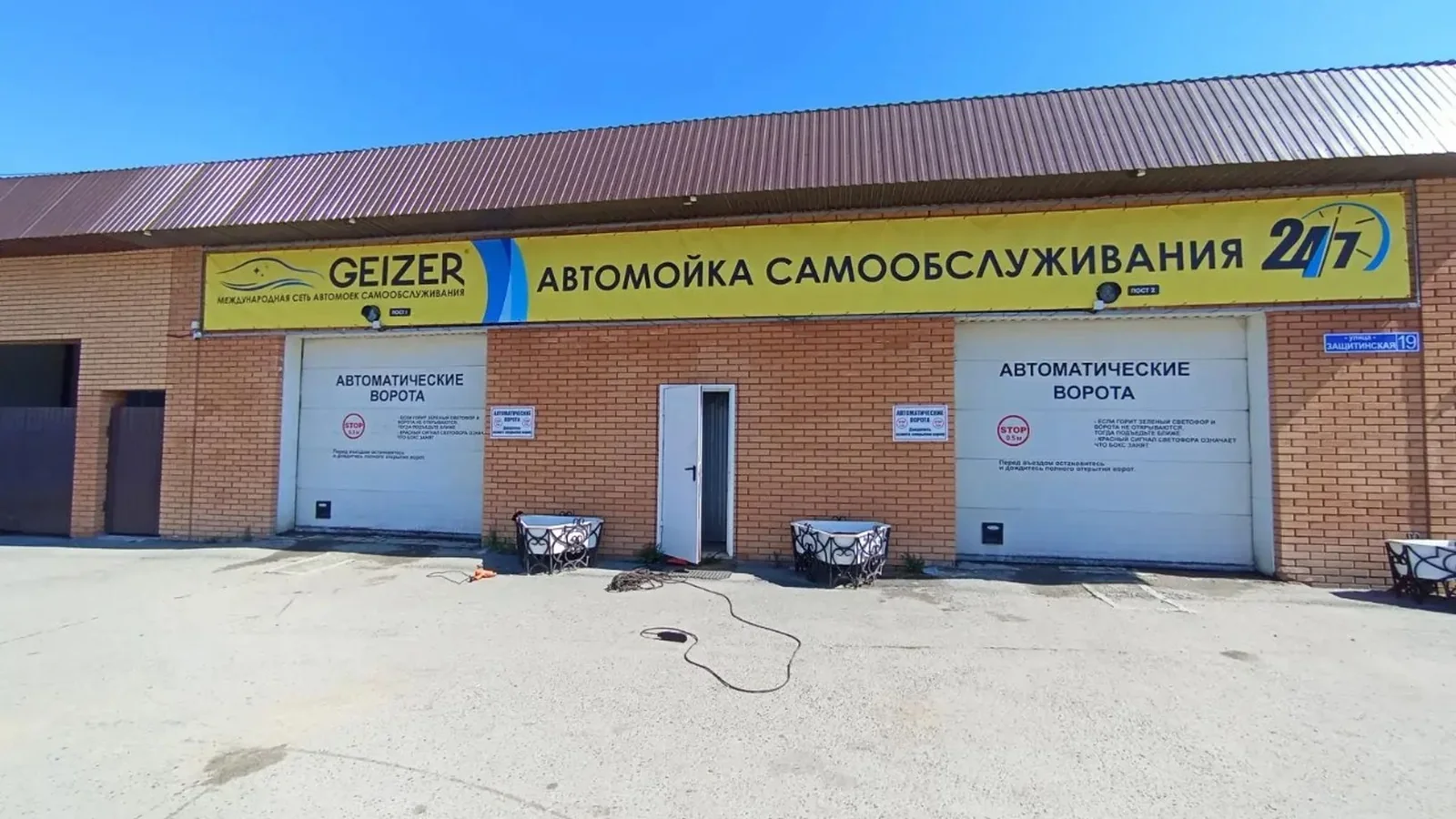
The network currently has 199 washes in 69 cities, owned by partners rather than the company. Day to day, customers wash their cars and pay at the bay, while owners see revenue, utilisation and faults in the account dashboard on their phones. Someone is still needed on site for cleaning, loading chemicals and minor tasks, so this is a business with almost no staff, but not without involvement. We explain how to choose a wash franchise in the article how to choose a self-service car wash franchise.
Ask us the same questions as any franchisor: request the contract and locate every payment and the termination section. The royalty cost for your wash is shown by the calculator: set the bays, traffic and transaction value. This is a preliminary calculation, not an income promise.
Frequently asked questions
What is an initial franchise fee, in simple terms?
It is a one-off payment to the franchisor for joining the network. It usually grants the right to use the brand, standards, training and launch assistance. It is paid once, when signing the contract or before opening the outlet.
What are royalties, in simple terms?
A regular payment to the franchisor, usually monthly, for continuing to operate in its network. Royalties fund the network's brand, software, training and partner support. They may be a percentage of revenue or a fixed amount.
How does the initial franchise fee differ from royalties?
The initial fee is paid once on entry; royalties are paid regularly throughout operation in the network. The fee covers launching and the right to join; royalties cover what the network does for you every month.
Which is better: percentage or fixed royalties?
A percentage rises and falls with revenue: payment is lower in a weak month, and the network has an interest in your sales. A fixed amount is easier to plan but weighs more heavily in the first months and off-season. Calculate both using your own figures, including a bad month.
Are there franchises without royalties?
Yes. But the network's income is then usually included elsewhere: a markup on mandatory purchases, a large entry fee or separate monthly charges. Find out exactly where before deciding that such a franchise is cheap.
What hidden payments can a franchise have?
Common examples include a marketing fund, software and CRM fees, markups on mandatory purchases, paid training for new staff, contract-renewal fees and penalties. Ask for the complete payment list in writing and compare it with the contract.
When do royalty payments begin?
It depends on the contract. A fair arrangement starts when the outlet operates and earns revenue. If royalties accrue from signing, you may pay for several months while the outlet is being built.
What are the initial fee and royalties in the GEIZER franchise?
The initial fee is 0 ₽. Royalties are 5% of an operating wash's revenue: no royalties are due before opening. In return, the partner receives the brand, CRM and account dashboard, app, support and software updates. Equipment starts at 450 000 ₽ per bay, including delivery, installation, commissioning and training.