
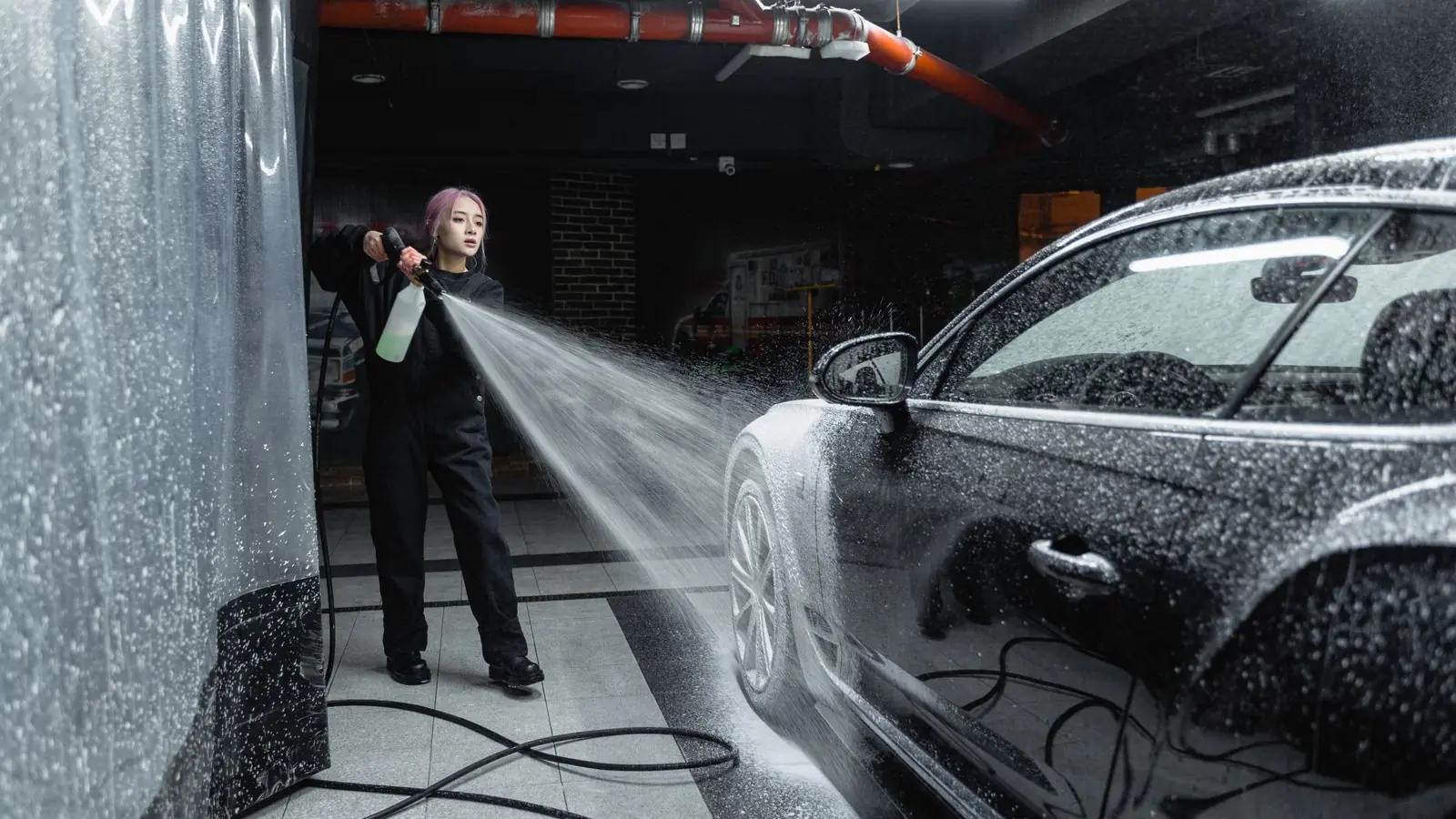
Who works at a self-service wash
At a conventional wash, vehicle washers are a major expense: there are several per shift, and they determine both quality and speed. A self-service wash has no vehicle washers: drivers clean their own cars and pay at the bay by card, SBP or QR code, so there is no cashier either. This leads to the common misconception that such a wash needs no people at all.
In practice, a self-service wash usually has three roles.
- Owner or manager. Monitors revenue and utilization and handles pricing, advertising and suppliers. These tasks can be done remotely.
- Attendant, also called a caretaker or administrator. The person who visits the site to clean, refill chemicals, monitor bays and help customers. This is the role meant by 'self-service car wash attendant'.
- Service team. Equipment repair and scheduled maintenance. This is usually provided by the equipment supplier or a service company rather than a permanent employee.
What a wash attendant does every day
An attendant has a short but regular task list. Leave it undone and within a week the wash looks neglected and customers move to competitors.
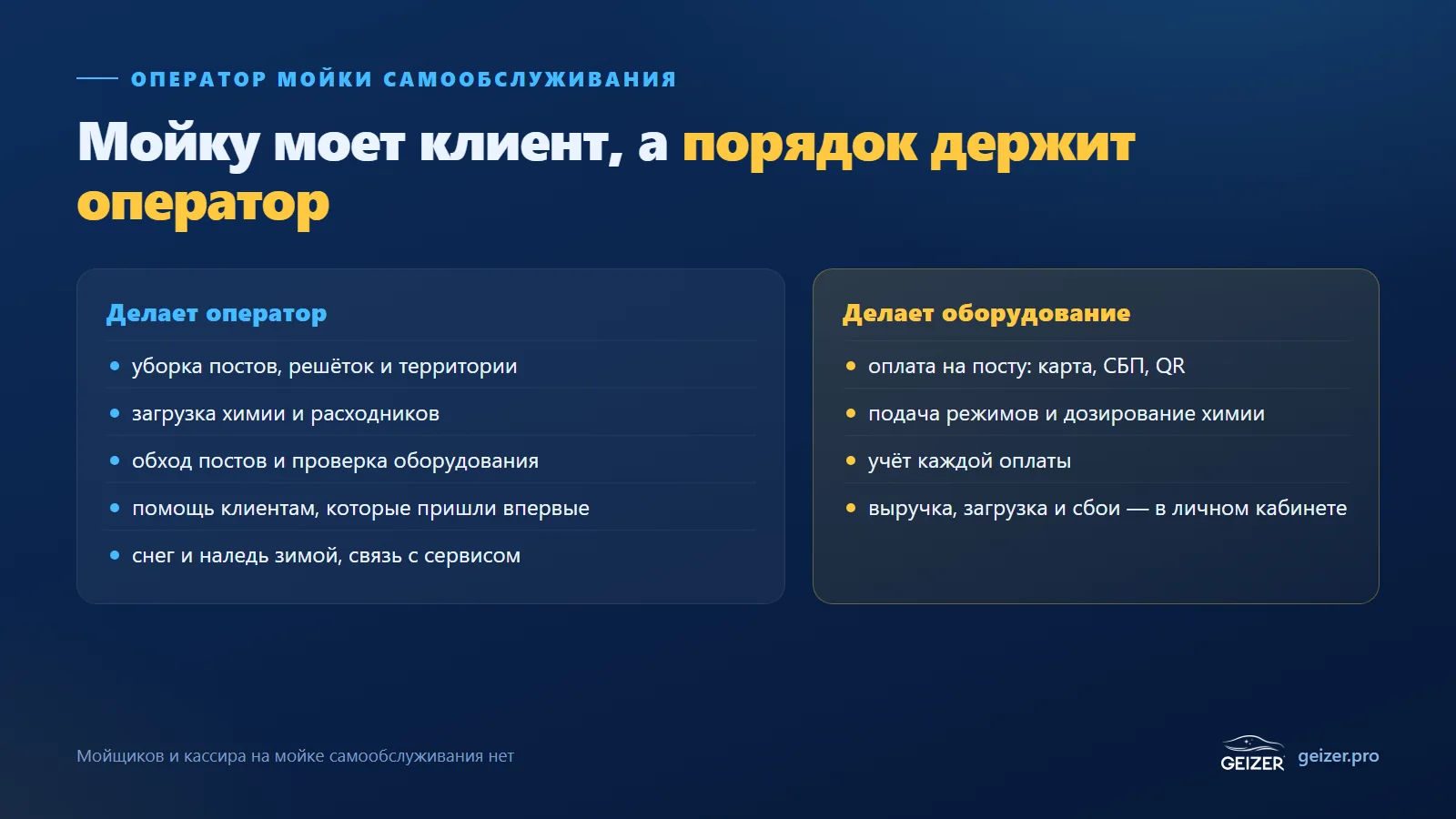
- Cleaning. Bays, grates and dirt traps, grounds, bins and the vacuum area. Cleanliness is the first thing customers use to choose a wash.
- Chemicals and consumables. Refilling and checking chemical levels and replacing consumables. Running out of foam means losing customers.
- Bay inspections. Check whether spray guns work, whether there are leaks, whether programs dispense correctly and whether instructions are readable.
- Helping customers. Show a first-time visitor how to use the bay, resolve a failed payment or receive a complaint.
- Seasonal work. In winter, clear snow at the entrance and ice near bays; in summer, keep the grounds and vacuum area tidy.
- Contact with the owner and service team. Report breakdowns, photograph problems and meet the service engineer.
What attendants normally do not do: wash vehicles or take cash for washing. If they do this at your wash, it is a different format and should be costed differently.
What automation does instead of people
The main reason one person can look after several self-service bays is that the equipment handles a substantial part of the work.
- Payments and records. Customers pay at the bay and every payment is recorded. Nobody needs to staff a cashier's desk or count the takings.
- Wash program delivery. Water, foam, wax and reverse-osmosis water: the bay doses chemicals and switches programs automatically.
- Operation monitoring. The owner can see revenue, bay utilization and fault alerts in the owner account. We explain what this looks like in the article Managing a car wash online.
The attendant is therefore needed to keep the wash clean, stocked and in good repair, rather than to operate the washing process itself. These are different tasks with different workloads.
How many people a self-service wash needs
There is no exact staffing standard: numbers depend on bays, traffic, season and how much you are willing to do yourself. The following gives a practical guide.
- A small wash with 2–3 bays. One person visiting several times a day, in the morning, at lunchtime and in the evening, with the owner as backup, is often enough.
- A busy wash with 4–6 bays. Someone should be continuously on site during peak hours, especially on weekends and in the busy season.
- Around-the-clock wash. Usually nobody needs to be on site overnight, but someone must be reachable if anything happens.
It is worth keeping more people on site during the first months after opening. Customers are still learning how to use the bay, and a person nearby who can show which programs to use and in what order can turn a confused newcomer into a regular customer.
Full-time or visiting staff
There are three common arrangements, each with its own cost.
- A full-time attendant. The wash is always tidy and customers get help. However, the salary is a fixed expense regardless of revenue, including in the quiet season.
- A visiting employee. Cleans and refills on a schedule and spends the rest of the time elsewhere. This costs less, but nobody is at the site during peak periods.
- The owner personally. This suits a wash close to home with only a few bays. It saves money but ties you to the site.
Attendant salaries vary widely between cities and public data for Russia is limited. To budget for staffing, check self-service wash attendant and car wash administrator vacancies on job sites in your city.
How to find and assess an attendant
Car wash experience is not essential: the necessary tasks can be taught in a few days. Other qualities matter more.
- Attention to cleanliness. Cleaning and checks make up 80% of the job. A person who does not notice dirt is not suitable for a wash.
- Responsibility without supervision. Attendants work alone most of the time, so you do not see how they do their job.
- A calm approach to customers. Sometimes they must deal with unhappy customers whose payment failed or whose foam ran out.
- Living close to the site. Someone living nearby can get there faster if something happens.
Assess work using facts rather than impressions: photos of clean bays at the start and end of a shift, a record of chemical refills and reports of problems. You can already see revenue and faults in the owner account, so supervision does not require your presence.
Staffing mistakes owners make
- Hiring nobody at all. Advertising calculations that say no staff are often taken literally. Within a month, dirty bays and empty chemical containers reduce traffic.
- Keeping more people on site than necessary. A habit inherited from conventional washes: at a self-service site, an extra person is an ongoing expense with no added benefit.
- Not providing training. An attendant who cannot use the bay cannot help a customer.
- Not providing contact with the service team. A minor fault that could be solved over the phone in an hour is left waiting until the owner visits.
How this works in the GEIZER network
Our position is simple: a self-service wash operates with very few staff, but still requires involvement. BRIZ equipment, which we manufacture in Barnaul, handles most operations: bay payments by card, SBP or QR code, program delivery and records. The owner needs someone to clean the grounds, refill chemicals and do minor jobs, while revenue, bay utilization and fault alerts can be viewed in the owner account from a phone.
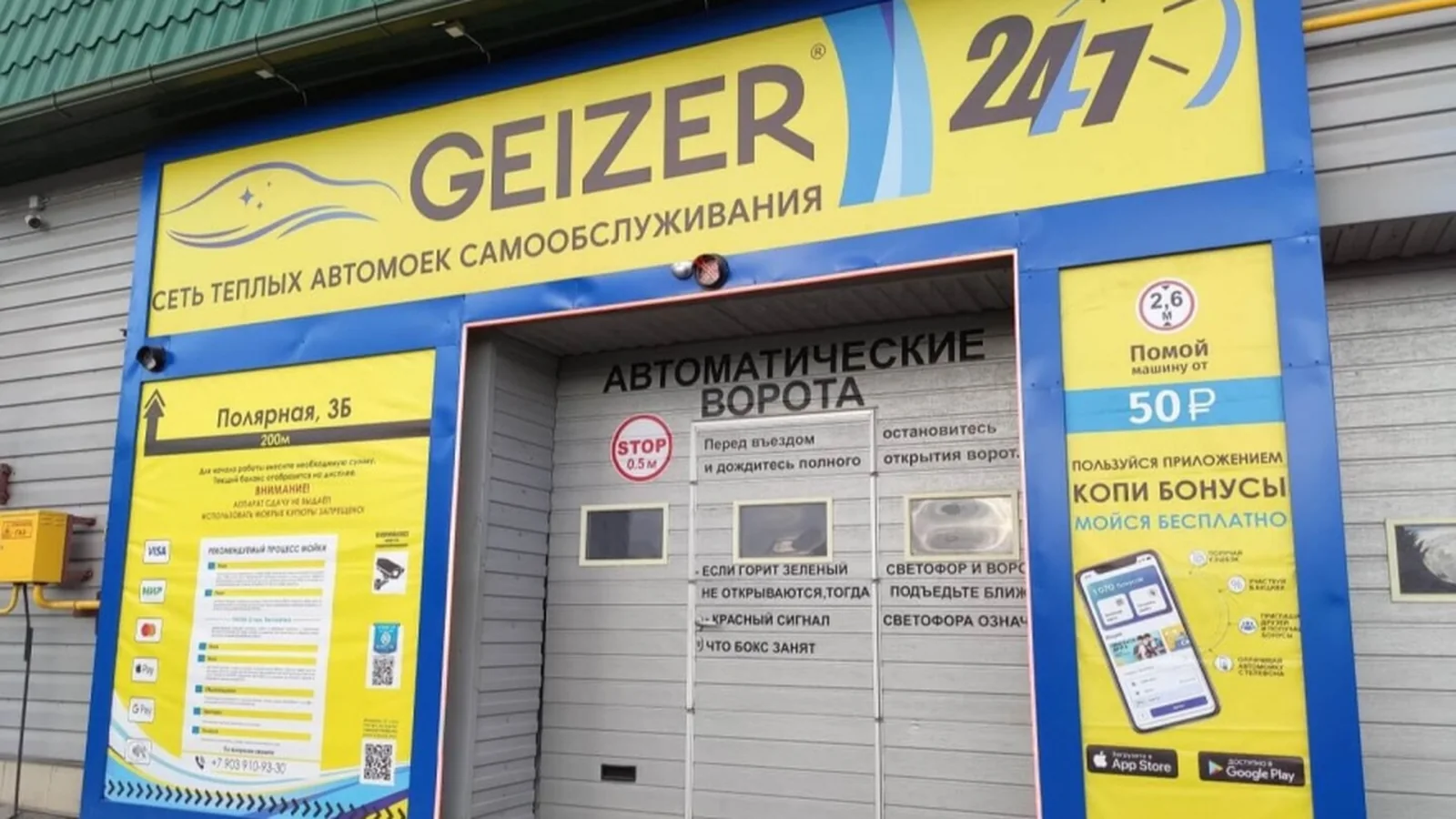
At launch, we train staff to use the equipment, while the service team handles scheduled maintenance and repairs. The network currently has 199 washes in 69 cities. The basic equipment set costs 430,000 ₽ per bay, and the franchise starts at 450,000 ₽ including delivery, installation, commissioning and training. You can estimate operating costs including staffing with the calculator: enter your bays, traffic and average transaction. This is a preliminary estimate, not a promise of income.
Frequently asked questions
Does a self-service car wash need an attendant?
Yes. There are no vehicle washers or cashier, but someone must clean the bays and grounds, refill chemicals, monitor equipment and help first-time customers.
What does a self-service car wash attendant do?
They clean bays, grates and grounds, refill chemicals and consumables, inspect bays and check operation, help customers, clear snow in winter and report breakdowns to the owner and service team. They do not wash vehicles.
How many employees does a self-service wash need?
There is no fixed standard. For 2–3 bays, one visiting attendant with the owner as backup is often enough. A busy 4–6 bay wash needs someone continuously on site during peak hours.
Does around-the-clock wash need an attendant at night?
Usually no one needs to stay on site at night, but someone must be reachable if equipment fails or a payment problem arises.
How does an attendant differ from a car wash administrator?
At a self-service wash this is usually the same role: someone who keeps the site in order and helps customers. At a staffed wash, an administrator more often supervises the shift and takes payments.
How much does a self-service car wash attendant earn?
Pay varies widely between cities, and public data for Russia is limited. To budget for this expense, check self-service wash attendant and administrator vacancies in your city.
Can a self-service wash be managed without staff on site?
The bays can: revenue, utilization and faults are visible in the owner account. However, someone still has to clean, refill chemicals and do minor jobs on site.