
Why one question gets two opposite answers online
Search for “should you rinse off wax at a self-service car wash” and you will get roughly equal numbers of “of course you should” and “absolutely not”. The people arguing are not wrong. They are talking about different substances and calling them by the same word.
At least two different things are called wax. The first is a solid or liquid protective wax from a car accessories shop: it goes onto a dry body, is buffed in, left to cure and not rinsed off. The second is drying wax, the one that comes out of the gun in a self-service bay. It has different chemistry and a different job, and it has to be handled the other way round.
Everything written online about “apply and leave to cure” refers to a different product.
What drying wax is
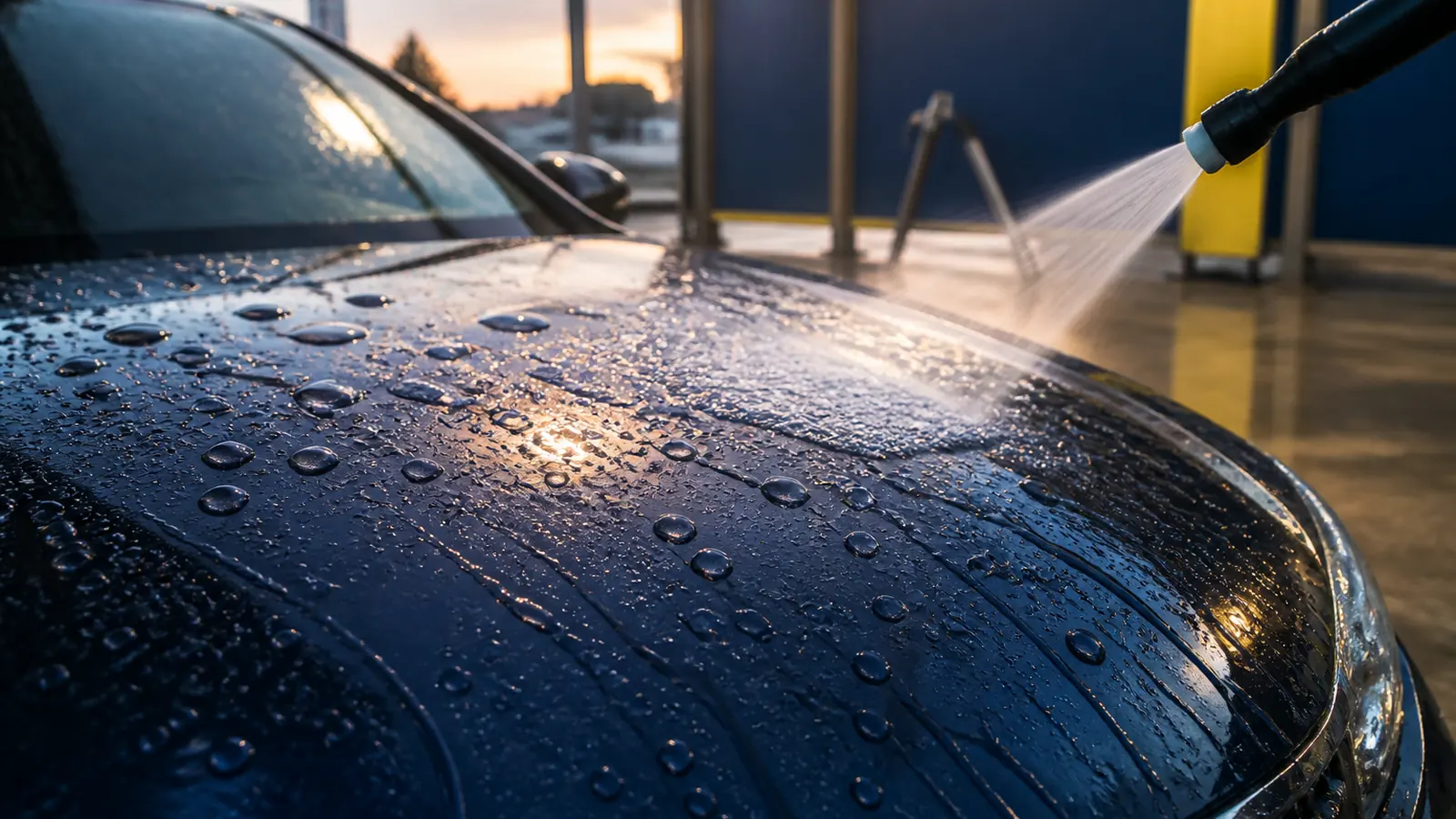
Its job is not to protect the clear coat for months but to change how water behaves on the body right now. After a rinse, ordinary water lies on the clear coat as a continuous film and dries slowly, leaving behind everything that was dissolved in it. Drying wax breaks that film up: the water gathers into separate beads and rolls off under its own weight, and what stays behind evaporates faster and almost without a trace.
The data sheet of the product used in the bays puts it exactly like this: it “breaks the water film into separate beads that quickly slide off the surface of the car” and “leaves a protective film that resists further soiling”. Hence the name — a drying agent. Protection here is a side effect, pleasant as it is.
Why it goes on evenly even though nobody buffs it in
This is the most interesting thing about this chemistry, and it also explains half of the rules for handling it.
Car shampoos for touchless washing — anionic, meaning that their active molecules carry a negative charge. After a wash with such a shampoo, the freshly washed clear coat keeps a weak residual negative charge. Drying wax is built on cationic surfactants, which carry a positive charge. From there it is ordinary physics: opposite charges attract, and the product settles onto the body by itself as an even, very thin layer. There is no need to buff it in, and nothing to buff it with — a bay has neither a cloth nor a machine.
Three practical conclusions follow from this, and we will come back to them: wax works only on a properly washed body, only on a wet one and right after the shampoo. If even one of these conditions is broken, there is nothing for it to be attracted to.
What wax gives and what not to expect from it
It gives three things. The car dries faster and noticeably more evenly — less chance of drop outlines appearing on the body. The body gains a fresh shine, especially in dark colours. And for a while dirt sticks to it less readily: the film keeps road dust and de-icing chemicals from gripping the clear coat.
Here is what it does not give. It is not polishing: wax neither removes nor hides scratches and hazing of the clear coat. It is not a ceramic or a glass coating: it does not last for months. And it is not a substitute for washing — on a dirty car it does not work at all, more on which below.
One more property worth knowing: water hardness has no effect on drying wax. Shampoo loses strength in hard water, while wax works just the same — the product data sheet states this directly. That is why in cities with heavy water it makes a particularly visible difference: it is the salts in the water that leave those whitish streaks.
When wax is useless and when it is harmful
On a dirty body it is useless and worse than that. The film will lie on top of the road grime and seal it in instead of protecting the clear coat. If you are not sure whether you washed the car clean, there is a simple test: run a white cotton pad over the wet body. If it stays white, the wax is worth taking.
On a dry body it will go on in patches. The product is designed to land in the water already present on the clear coat and spread out with it. On a body that has dried off it stays where the spray hit and dries into uneven streaks.
Not as the first programme. The logic is simple: first take the dirt off, then the chemistry, then the rinse, and only at the end the looks. The full order of programmes is covered in a separate article — how to wash a car at a self-service car wash.
How to apply it
Wax comes out at low pressure in a wide soft spray — this is not the jet you knock dirt off with. Holding the gun close is neither necessary nor useful: at about an arm's length from the body the spray lands most evenly.
Go top to bottom, unhurried, without gaps: the roof, the glass, the bonnet and the boot lid, then the sides. A passenger car takes twenty to forty seconds — that is enough; there is no point going longer, the layer will not get any thicker.
Do not forget the glass: that is where streaks show most, and where the difference wax makes is easiest to see.
In a self-service bay the meter counts seconds. Twenty seconds of careful application give the same result as a hurried minute — and cost three times less.
Rinse it off or not — a straight answer
After wax the bay runs a final rinse, and it should not be skipped. That is precisely the “rinse” people argue about.
The data sheets of the products loaded into the bays say it literally: “apply to a wet body after washing and rinse off with plenty of water” and “spray onto a wet body and rinse off with water from the high-pressure washer”. In other words, the manufacturer explicitly prescribes a rinse.
It is worth understanding what happens then. The rinse removes the excess the part of the product that has not bonded to the clear coat and would otherwise dry as streaks. The very thin layer pulled to the body by charge is not washed off by water: it is the result. So “rinse off” here does not mean “wash clean away”.
A word about the rinse water. If the bay has a programme called osmosis do the final rinse with it. Ordinary water carries salts, and once it dries they will leave on the fresh wax exactly the streaks you took it to fight. Osmosis water contains no such salts.
The short formula: wax → osmosis → blow-drying, and nothing in between should be skipped.
Why you must not wipe the car after wax
This is the most common and the most galling mistake. Someone washes the car carefully, takes the wax, rinses — and then pulls a cloth out of the boot.
A cloth wipes off the film you paid for. On top of that, it picks up the remaining water together with the grains of sand that always stay on the clear coat after a wash, and drags them across the whole surface. On dark cars the result is visible in the sun for years as a web of fine scratches.
Drying should be done with the air blower: the air touches nothing. And after wax, drying takes half as long — the water has already run off by itself.
How long it lasts and what changes in winter
Honestly: not long. Drying wax lasts from one wash to the next — usually a week or a week and a half, after which the effect fades away. It is a consumable, not a coating, and it makes sense to take it every time rather than “once for the season”.
In winter it is more useful than in summer, for two reasons. The first is de-icing chemicals. The film keeps the salt slush from gripping the clear coat and the wheel arches, so the next round of dirt comes off more easily. The second is water. The faster the body dries, the less water is left in the door openings, the locks and the seals — and the smaller the chance of not being able to open a door in the morning. More about winter in a separate article.
And one point that wax does not cure: if after the wash you have not blown out the mirrors, the door openings and the locks, no wax will save you from things freezing shut. It speeds drying up, but does not replace it.
Frequently asked questions
Should you rinse off wax at a self-service car wash?
Yes, a final rinse comes after the wax, and it should not be skipped. The data sheets of the products loaded into the bays say it plainly: apply to a wet body and rinse off with water. The rinse removes the excess that would otherwise dry as streaks, while the thin layer drawn to the clear coat is not washed away by water — that layer is the result. If the bay has osmosis water, rinse with it: ordinary water leaves salts and water spots.
Do you need wax at a self-service car wash?
It does three things: the car dries faster and more evenly, the body has a fresher shine, and for a while dirt sticks to it less readily. In winter it is more useful than in summer, because it stops de-icing chemicals from gripping the clear coat. But it is a consumable that lasts a week or so, not a protective coating for the season.
How do you apply wax properly at a self-service car wash?
Onto a body that is already clean and definitely wet, top to bottom, unhurried and without gaps. Hold the gun further away than when knocking dirt off — about an arm's length — so that the spray lands evenly. Twenty to forty seconds is enough for a passenger car. Do not skip the glass: that is where the difference shows most.
Why wax does not work on a dirty car
Drying wax is built on cationic surfactants and settles on the body because of its charge: a freshly washed clear coat carries a weak negative charge after an alkaline shampoo, and the product carries a positive one. On a dirty surface there is nothing to attract it — the film simply lies on top of the dirt and seals it in. You can check for cleanliness with a white cotton pad on the wet body: if it stays white, the wax is worth taking.
Can you wipe the car with a cloth after wax?
Better not. A cloth wipes off the very film you paid for and, on top of that, drags grains of sand left after the wash across the clear coat. On dark cars this turns into a web of fine scratches that shows up in the sun. Drying should be done with the air blower — after wax it takes half as long, because the water has already run off.
How is wax at a car wash different from wax from a shop?
These are different products with different jobs. A solid or liquid wax from a car shop goes onto a dry body, is buffed in and left to cure — it is not rinsed off. Drying wax in a bay goes onto a wet body, settles by itself because of its electric charge, and is followed by a rinse. It is the confusion between these two things that produces the two opposite answers online about whether to rinse it off.