
Why there are two opposite answers online
The question “can you wash the engine at a self-service car wash” gets two answers online, both categorical: “of course you can, everybody does” and “never, you will fry the electronics”.
The truth is that both camps are quoting real experience. Some wash for years with no consequences — because their car is simple, they hold the gun far away and spray at a glancing angle. Others flooded a control unit once and paid for it what half a year of car washes would cost.
The difference is not luck. It comes down to three things: what kind of car it is, what was covered before the wash, and from what distance the water was applied. We will take them in order — and say honestly where we ourselves advise against taking the risk.
The engine bay is not worth washing with a high-pressure jet. A self-service bay is designed for bodywork. Engines are cleaned differently — with steam, or with chemistry followed by a careful rinse.
What exactly is afraid of pressurised water
It is not about water as such — it gets under the bonnet in the rain too. It is about pressure. The jet from the gun forces its way past seals designed for splashes, not for a direct hit.
The first to suffer are the electrical connectors. They have rubber seals that harden over the years, and pressurised water gets inside. Then comes contact corrosion — and a fault that shows up not today but a week later in damp weather.
Control units on some cars sit right in the engine bay. A flooded unit is the most expensive item on this list.
The alternator is open by design: it has ventilation openings that let air in. Water goes in through them just as easily.
Ignition coils and spark plug wells. Water in a plug well means misfires and a rough idle, sometimes immediately after the wash.
The air intake. Water getting into the intake is the nastiest scenario of all, and on some cars it is entirely achievable.
When it is better not to start at all
There are cases where the risk is noticeably above average, and we would advise against it.
A car with age and mileage. The older the seals, the less they seal. On a new car a connector keeps water out; on a fifteen-year-old one it no longer does.
There have been traces of damp or electrical faults. If the car is already temperamental in damp weather, washing the engine will make it worse.
A hot engine. Cold water on a red-hot exhaust manifold or cylinder head is thermal shock. Let the car cool down for at least half an hour.
Frost. Any water left behind freezes in the same connectors and lines, and the consequences do not show up straight away.
You are washing in order to sell. A separate case: a clean engine bay makes a buyer suspicious rather than delighted — it is often used to hide leaks. Sometimes it pays not to wash it.
If you wash it anyway — how to cut the risk
Since some people will wash it anyway, here are the rules that genuinely work.
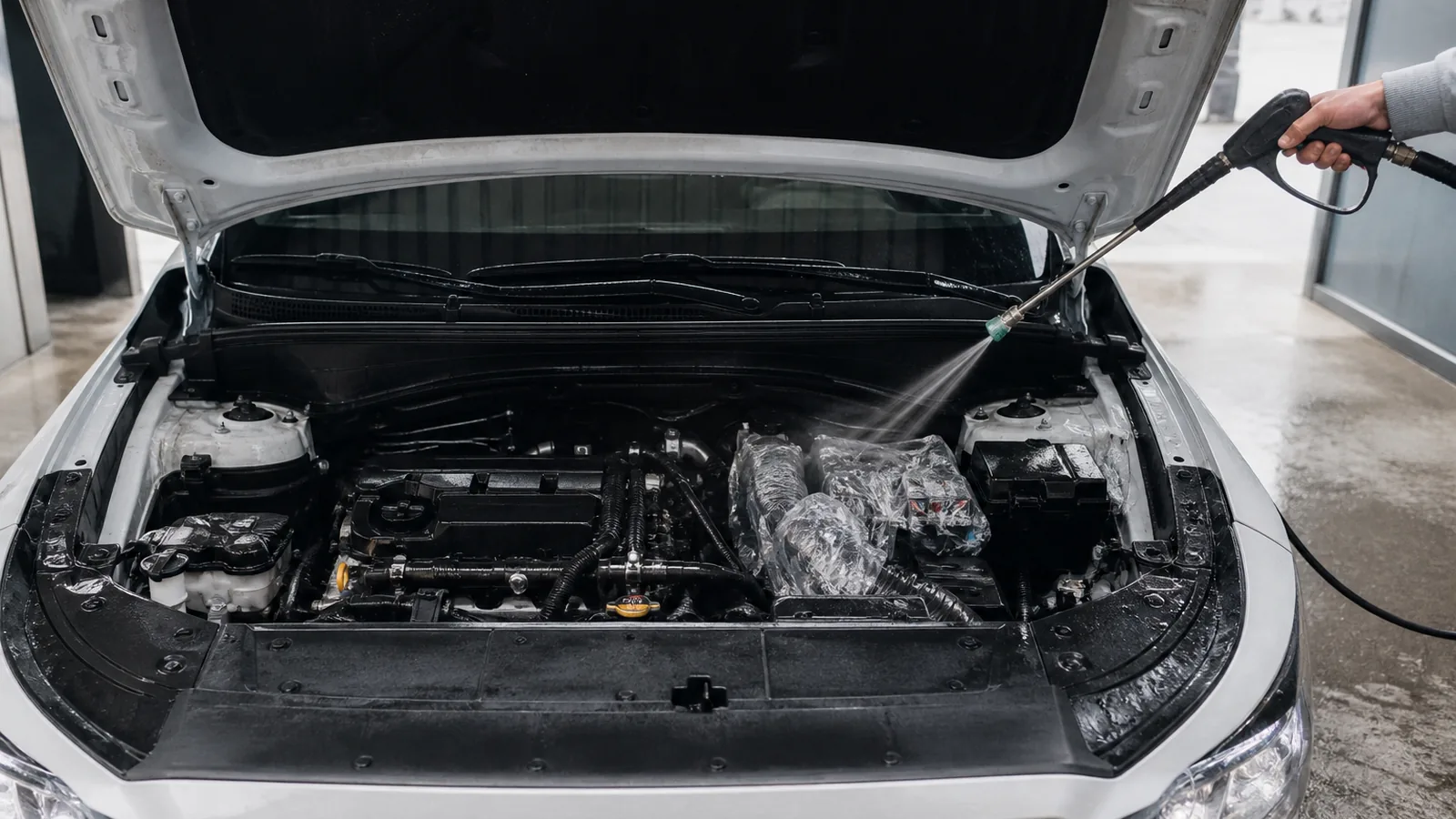
Cover whatever must not get wet. Thick plastic sheet and rubber bands: the connectors, the fuse box, the alternator, the air intake, the spark plug wells if they are exposed. Five minutes of preparation costs less than any single item on that list.
The engine warm, but not hot. Warm metal gives up dirt more easily but causes no thermal shock.
Not point-blank and not head-on. Keep at least an arm's length away and spray at a glancing angle, not straight on. The job is to rinse, not to blast.
Chemistry goes on the dirt, not on everything. Apply the product to the dirty areas, let it work and rinse it off. There is no point in drenching the whole bay in chemistry. To choose a product, see in the catalogue of car wash chemistry.
Spend longer drying than washing. Take the plastic off, blow everything out with compressed air if you have it, and do not start the car straight away. Let it stand with the bonnet open — twenty minutes at the very least.
If the car will not start or runs rough after the wash
First: do not crank the starter over and over. With water inside, every attempt only makes it worse.
Open the bonnet and let the car stand with it open — that is often enough, and in warm weather the water clears by itself within an hour or two. If you can, blow out the spark plug wells and the connectors with compressed air.
If the symptoms remain after everything has dried, or a warning light comes on, that is a job for an auto electrician, and it is better not to put it off: contact corrosion does not go away with time, it progresses.
And a last point, without which this text would be dishonest: responsibility for washing the engine lies with the owner of the car. A self-service bay gives you water, chemistry and pressure; what you wash with them and how is your decision. That is precisely why we have described the risks as plainly as we can.
Frequently asked questions
Can you wash the engine at a self-service car wash?
With a high-pressure jet — better not. Pressurised water forces its way past connectors and gets where it should not be: into control units, ignition coils, the alternator. A self-service bay is designed for bodywork. The engine bay is cleaned differently — with steam, or with chemistry and a careful rinse. If you wash it anyway, cover the connectors and keep the gun far away and at a glancing angle.
What has to be covered before washing an engine?
With thick plastic sheet and rubber bands: the electrical connectors, the fuse box, the alternator, the air intake and the spark plug wells if they are exposed. Five minutes of preparation costs less than any single item on that list. The alternator is especially vulnerable: it has ventilation openings, and water goes straight in through them.
Can you wash a hot engine?
No. Cold water on a red-hot exhaust manifold or cylinder head is thermal shock. Let the car cool down for at least half an hour. It is best to wash a warm engine: warm metal gives up dirt more easily, but there is no longer a sharp temperature difference.
What to do if the car will not start after washing the engine?
Do not crank the starter over and over — with water inside, every attempt makes it worse. Open the bonnet and let the car stand: the water often clears by itself within an hour or two. If you have a compressor, blow out the spark plug wells and the connectors. If the symptoms remain after everything has dried, or a warning light is on, take it to an auto electrician, and sooner rather than later: contact corrosion does not go away with time, it progresses.
Is it worth washing the engine before selling the car?
Not always. An experienced buyer is wary of a perfectly clean engine bay: washing is often used to hide oil and coolant leaks. Sometimes an honest engine with an ordinary film of grime inspires more trust than an immaculate bay.