
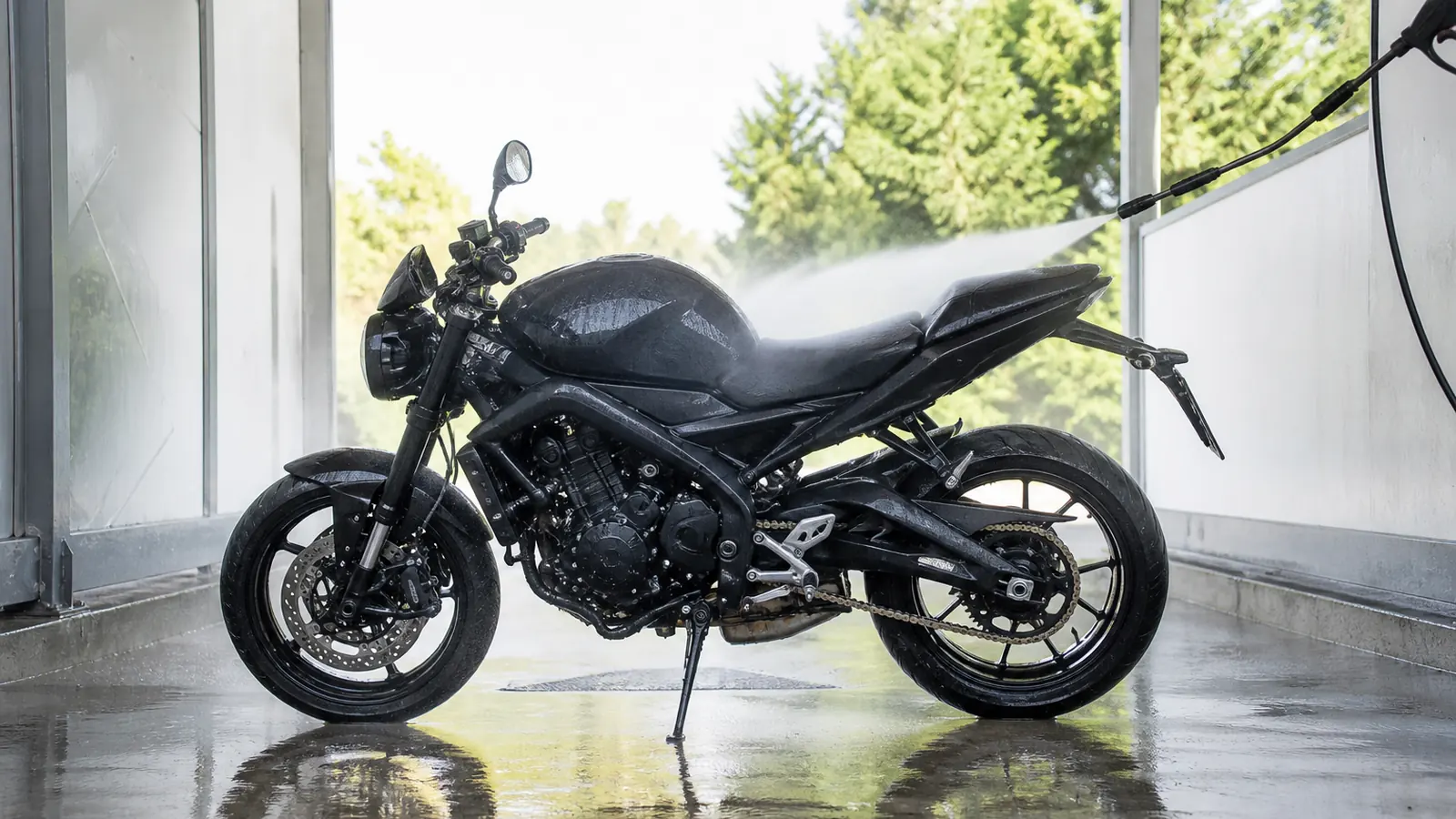
Why a motorcycle must not be washed like a car
On a car almost everything vulnerable is hidden away: the bearings in the hubs, the electrics under the bonnet, the drives in their casings. On a motorcycle exactly the same things are outside and in plain view.
The jet from the gun gets in where rain never reaches: under a bearing seal, into a connector, inside a hub, between a pad and a disc. The grease washes out in a few seconds, and the consequences do not show at once — a week later there is play or a grinding noise, and by then nobody thinks to connect it with the wash.
With a bicycle the logic is the same and so is the kind of mistake, only cheaper: the bottom bracket, the hubs and the headset wash out just as readily.
Further away, gentler and never straight on. The jet should pass at an angle rather than hit head-on.
Where not to aim
Bearings and seals — the wheel hubs, the headset, the swingarm. This is the first thing to wash out, and the most expensive item on the list.
The chain and sprockets. The jet knocks the lubricant out of the rollers and the water stays inside. Then comes rust and a stretched chain.
The brake discs and calipers. Chemistry should not go on them at all, and water only at an angle. Residue on a disc reduces braking efficiency for the first few metres.
The instrument panel, the connectors, the ignition lock, the fuse box. The seals there are made for rain, not for pressure.
The exhaust, if the engine is hot. Cold water on a red-hot pipe risks warping the metal. Let it cool down.
The air intake and the breather. Water in the intake is the nastiest scenario, and on a motorcycle it is easier to achieve than on a car.
The order of the wash
1. Let the machine cool down. At least twenty minutes after the ride.
2. Cover what you can. A bag over the instruments and the ignition lock, a cloth over the exhaust — that covers ninety per cent of cases.
3. Knock the dirt off with water, from a distance. Not twenty centimetres as on a car body, but half a metre and more. Top to bottom.
4. Foam — yes, but not everywhere. A touchless product removes road film from the plastics and the frame well. It is not applied to the brakes, the chain or exposed bearings.
5. Let it dwell for one or two minutes, without letting the foam dry out.
6. Rinse — again from a distance, from the top down.
7. Dry with the blower. On a motorcycle this is not a luxury: air blows the water out of the gaps a cloth cannot reach.
The chain, and what you must do after the wash
This is the step that gets skipped most often, and it is the one that turns a careful wash into an expensive repair.
Go for a ride. Five to ten minutes of gentle riding drives the water out of the brakes and dries what the blower could not reach. Brake softly and early at first: wet pads bite worse.
Lubricate the chain. Without fail and straight away, while it is still warm from the ride. Even if you never pointed the jet straight at it, some of the lubricant has gone.
Check that no water is left anywhere — in the headlight, under the seat, in the battery compartment.
And the thing without which this text would not be honest: responsibility for washing a machine lies with its owner. The bay provides water, chemistry and pressure; where and from what distance you use them is your decision. That is exactly why we have set out the risks as plainly as we can.
Frequently asked questions
Can you wash a motorcycle at a self-service car wash?
You can, but not the way you wash a car. On a motorcycle the bearings, the chain, the electrics and the brakes are all exposed, and a jet at point-blank range washes the grease out in seconds. Hold the gun half a metre away or more, take the jet across at an angle rather than straight on, and do not aim at the hubs, the chain, the brakes or the connectors.
Can you wash a motorcycle chain under pressure?
Better not. The jet knocks the lubricant out of the rollers and the water stays inside — then comes rust and a stretched chain. A chain is cleaned with a dedicated product and a soft brush, and after any wash it must be lubricated again while it is still warm from the ride.
What to do immediately after washing a motorcycle?
Ride gently for five or ten minutes: that drives the water out of the brakes and dries the gaps. Brake softly and early at first — wet pads bite worse. After the ride, lubricate the chain and check that no water is left in the headlight, under the seat or in the battery compartment.
Can you use active foam on a motorcycle?
On the plastics, the frame and the tank — yes, a touchless product removes road film well. On the brake discs, the calipers, the chain and exposed bearings it should not go: residue on a disc makes braking worse for the first few metres, and chemistry washes the lubricant out of the chain.
Can you wash a bicycle at a self-service car wash?
Yes, and the rules are the same as for a motorcycle, only gentler still. The bottom bracket, the hubs and the headset wash out under pressure just as readily. Keep your distance, do not aim at anything with bearings in it, and after the wash dry the chain and lubricate it.