
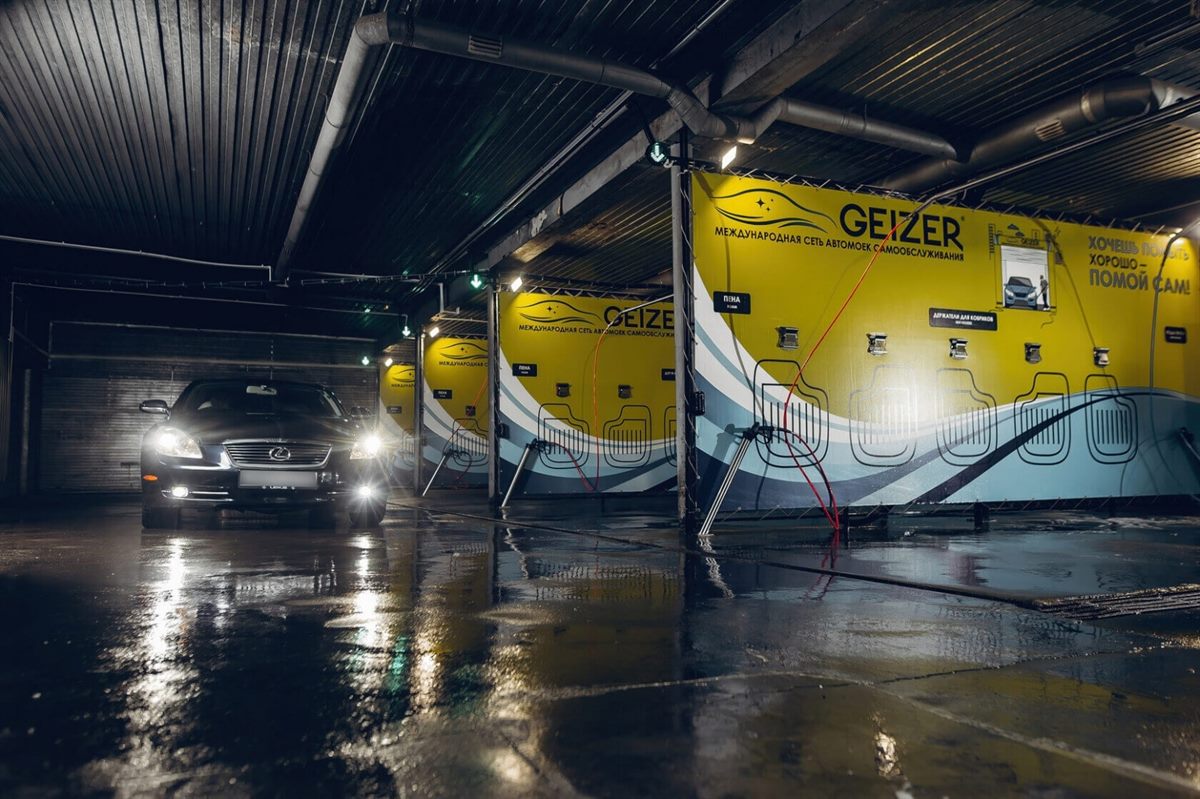
The order matters more than the pressure
A self-service car wash is simple: you pay for time and choose the programme yourself. There is exactly one way to get it wrong — to mix up the order. Almost all complaints about streaks, stripes and “it looked worse after the wash” come down to someone starting from the wrong step.
The logic runs like this. First the heavy dirt and sand come off the body — with water, without any chemistry. Then the foam goes on and softens what is left. Then all of it is rinsed away. And only at the end comes the appearance: wax, the final rinse, drying. Swap the steps around and you will be dragging sand across the clear coat.
The set of programmes differs from bay to bay, but the order on the selector is already arranged correctly. Work down it and skip whatever you do not need.
What each programme does
The names on the terminals differ, but bays have much the same set of functions. Here is what follows what and why it is there.
- Underbody wash — nozzles underneath knock road salt and dirt off the wheel arches and sills. Especially important in winter and early spring.
- The pre-wash is pressurised water. The job is not to clean but to remove the sand so that it does not act as sandpaper in the next steps.
- Active foam is the main chemistry. It softens the road film and lifts the dirt off the surface so that it can simply be rinsed away.
- Rinse rinses the foam away together with the dirt.
- Brush is mechanical help for whatever the chemistry did not take off. Only on a body that is already washed.
- Wax is a thin protective layer. Water gathers into beads and rolls off after it, and the car stays clean longer.
- Osmosis is salt-free water for the final rinse. That is what makes the difference between streaks and none.
- Air blower is drying with air, without touching the body.
A bay may additionally have a vacuum cleaner, a screenwash filler, a tyre inflator and a mat beater are about the interior and the details; they come after the bodywork.
Step by step
1. Knock the dirt off with water. Go over the whole body at high pressure, holding the gun about 25–30 centimetres away. Closer is not needed: a point-blank jet can lift a seal, peel back the edge of a film or knock off a sticker. Start at the roof and work down — that way the dirt runs onto areas that have not been cleaned yet rather than the other way round.
2. Apply the foam from the bottom up. Here the direction changes, and it is not a whim. If you start at the top, the foam runs down in stripes over dry paint, and those stripes will show up later. Working upwards, the layer goes on evenly.
3. Let the foam do its work. One to three minutes. This is the one pause worth waiting through: the chemistry is doing the work for you. But watch that the foam does not dry out — dried foam becomes a source of streaks in its own right.
4. Rinse — again from top to bottom. Thoroughly, not forgetting the sills, the mirrors, the grille and the area under the spoiler. Foam left in the gaps will later run out in streaks over clean paint.
5. The brush — if you want it, and only now. If you use it, first rinse it with water to wash out the sand from the previous car. You never use a brush on a dirty body: it is the fastest way to get a web of fine scratches.
6. Wax. Applied to a clean and wet body, evenly, from top to bottom, about 20–40 seconds for a passenger car.
7. Finish and dry. Osmosis water removes the salts that leave whitish marks. Then the air blower — it dries without touching the body.
About wax: what it is and when it is useless
Wax in a bay is not polishing and not months of protection but drying wax: it changes how water behaves on the body so that the car dries evenly and without marks. It works only on a clean and wet body, and it is followed by the final rinse.
There is no need to rinse it off separately, and you must not wipe it with a cloth. Why that is so and how it differs from wax from a car shop is covered in detail in the article about wax at a self-service car wash.
In the heat both the foam and the water dry before you can rinse them off. The result is exactly the streaks the car wash then gets blamed for. In summer it is better to choose an enclosed bay or to wash in the morning and the evening.
Five mistakes that cost you the result
- Starting with the foam. The sand stays on the body and acts as an abrasive for the rest of the cycle.
- Holding the gun point-blank. The pressure is designed for a distance; point-blank it damages films, stickers and old paint.
- Letting the foam dry. Especially on dark cars and in hot weather.
- Taking the brush to a dirty body. One wash like that leaves marks that show in the sun for years.
- Skipping the drying. The drops dry by themselves and leave outlines — all that careful work is lost at the very last step.
In winter and in frost
In winter a wash matters more than in summer: road salt stays on the underbody and in the wheel arches. You can wash in the frost if the bay is warm — in the GEIZER network all the bays are heated, so the water does not set on the body while you are still washing.
After the wash spend an extra minute: blow out the mirrors, the door openings, the locks and the sills, and open and close the doors a few times. That way the water leaves the seals and the doors do not freeze shut. More on what happens to the equipment and the car in the cold in the article about a self-service car wash in winter.
How long it takes
A full cycle on a passenger car takes seven to twelve minutes if you do not rush and give the foam its pause. People usually try to save time on exactly that pause and on the drying — and that is exactly what produces the result they later regret paying for.
If you wash often it makes sense to split it up: a full cycle with foam and wax once every week or ten days, and a quick rinse with blow-drying in between. Water comes off waxed paint easily, and such an interim wash takes a couple of minutes.
Frequently asked questions
How long should the foam stay on the body?
One to three minutes — while the foam is working but has not yet begun to dry. The exact time depends on the weather: in the heat it is a matter of seconds, in cool weather you can safely wait three minutes. There is one main rule: the foam must not dry on the body.
In what order do the programmes run at a self-service car wash?
Usually like this: underbody wash, a preliminary rinse with water, active foam, rinse, brush, wax, final rinse with osmosis water, blow-drying. The set and the order differ from bay to bay, so follow the numbering on the terminal — it reflects how that particular station is set up.
How do you apply wax properly at a self-service car wash?
Wax goes onto a body that is already clean and wet, evenly and from top to bottom, about 20–40 seconds for a passenger car. On a dirty car it is useless: the layer will simply lie on top of the dirt. After wax comes drying or the final rinse — check the order of programmes in your own bay.
What is osmosis water for?
Osmosis is a rinse with water from which the salts have been removed. Ordinary water leaves whitish streaks as it dries, because the salts stay on the clear coat. After osmosis water there are no streaks, even if you do not wipe the car.
Can you wash the engine at a self-service car wash?
With a high-pressure jet — better not. Pressurised water forces its way past connectors and gets where it should not be: into control units, coils, the alternator. The engine bay is cleaned separately and by other means.
Can you wash a car in freezing weather?
In a heated bay — yes, that is what it is for. After the wash blow out the mirrors, the door openings and the locks, and open and close the doors a few times so the water leaves the seals. Otherwise the doors freeze shut in the cold.
Find your nearest GEIZER car wash →