
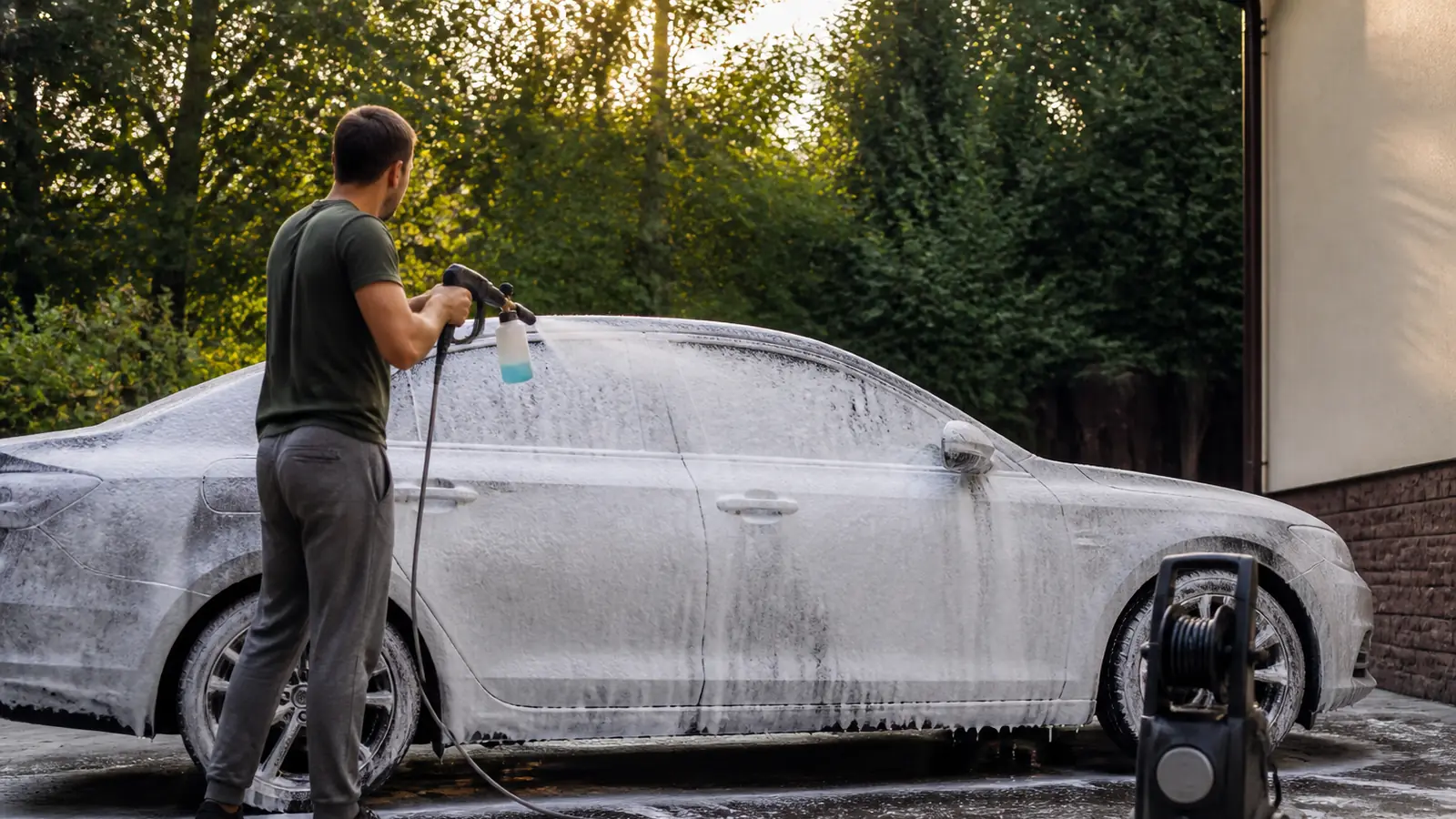
What works differently at home than at a bay
The logic of washing is the same: first knock the sand off with water, then chemistry, then rinse, then dry. But three things are different, and those are exactly where people go wrong.
The foam is different. At a bay there is a foam generator that mixes the concentrate into the flow itself at a ratio of something like 1:100. At home you have a foam nozzle on the gun: its bottle is filled with a solution that is already made up, and the ratio there is ten times finer — around 1:10. The same concentrate, different numbers. This is covered in detail in the article on dilution.
Lower pressure. A domestic machine is weaker than a bay, and that is no disaster: touchless washing cleans with chemistry and time, not with pressure. You simply have to give the foam an honest dwell time.
There is no osmosis. At a bay the final rinse is with water free of salts, and after it the body dries by itself. At home the water from the hose is ordinary, with all its salts, and when it dries it leaves streaks. Hence the main difference: at home you wipe the car.
The order of work
1. Find some shade. In the sun both the foam and the water dry before you manage to rinse them off, and streaks are guaranteed. Early morning or evening is better.
2. Knock the dirt off with water. The whole body, top to bottom, without chemistry. The aim is not to clean but to remove the sand, so that it stops acting as sandpaper.
3. Apply the foam from the bottom up. The direction changes for a reason: start at the top and the foam runs in stripes down a dry body, and those stripes show up later.
4. Let the foam work. One to three minutes. It is the one pause worth waiting through, and on a domestic machine it matters more than at a bay. Watch that the foam does not dry out.
5. Rinse from the top down. Thoroughly: the sills, the mirrors, the grille, the area under the spoiler. Foam left in the gaps will run out later in streaks over a body that is already clean.
6. Wipe it dry. More on that below — here everything at home is the opposite of a bay.
The distance, and what you must not spray at point-blank range
The working distance is about twenty-five to thirty centimetres. This is not caution for its own sake: a jet at point-blank range bends back the seals, lifts the edge of protective film, knocks off decals and finds the weak spots in old or resprayed clear coat.
Separately, where not to aim at all: the locks and lock barrels, the door vents and seals, the area around parking sensors and cameras, under the bonnet. On the engine bay there is a separate article, and the conclusion there is short: better not to go in with a high-pressure jet.
The turbo nozzle that comes in the box is meant for concrete and paving. It must not be used on clear coat.
Which chemistry to buy
The same touchless concentrate used at the bays will do — it is only a question of pack size and dilution. For home use it makes sense to buy 750 ml or 5 l: a twenty-kilogram canister, at one wash a week, will stand for years and lose its properties before it runs out.
What to look for on the datasheet: the dilution range specifically for a foam kit, the alkalinity and whether there are corrosion inhibitors. The signs are set out in the article on choosing a car shampoo.
What not to do: mix it by eye, “a bit stronger”. Excess alkali rinses off worse, dries into a whitish film and, over time, damages aluminium and chrome.
Drying: at home you wipe, and that is normal
At a bay you must not pick up a cloth after osmosis — it takes off the wax and drags grains of sand across the clear coat. At home the situation is different: there is no osmosis, the water from the hose carries salts, and if you leave it, it dries into spots.
So at home you dry with microfibre, but by the rules. Take a clean dry long-pile towel and work with it without pressure, blotting rather than rubbing. One towel for the body, a separate one for the sills and door openings: that is where the sand is. A towel that has already fallen on the ground goes out of use.
If you would rather avoid a cloth, there are two ways. The first is wax: after it the water runs off by itself and far less is left. The second is to blow the water off with a compressor or a leaf blower, if you have one.
Frequently asked questions
How do you dilute car shampoo for a foam nozzle?
The bottle of a foam nozzle is filled with a working solution that is already made up, so the ratio is fine — usually from 1:6 to 1:20 depending on the product. Do not confuse it with the figure for a foam generator: there it is 1:60 and above, because the device dilutes the concentrate itself. The exact range is on the product datasheet.
How far from the body should you hold the washer?
About twenty-five to thirty centimetres. Closer is dangerous: a jet at point-blank range bends back the seals, lifts the edge of protective film, knocks off decals and finds the weak spots in old clear coat. The turbo nozzle that comes in the box must not be used on the body — it is meant for concrete.
Do you need to wipe the car after washing it at home?
Yes. At home there is no osmosis, the water from the hose carries salts, and when it dries it will leave whitish spots. You wipe with a clean dry long-pile microfibre towel, blotting rather than rubbing. At a self-service bay it is the other way round: after osmosis a cloth does nothing but harm.
Can you wash a car in the sun?
Better not. Both the foam and the water dry before you manage to rinse them off, and the body is left with streaks. Choose shade, early morning or evening. The rule works the same at home and at a bay.
Which pack size should you buy for home use?
750 ml or 5 l. A twenty-litre canister, at one wash a week, will stand for years and lose its properties before it runs out. The product itself can be the same one used at professional bays — the only difference is the pack size and the dilution ratio for your nozzle.