
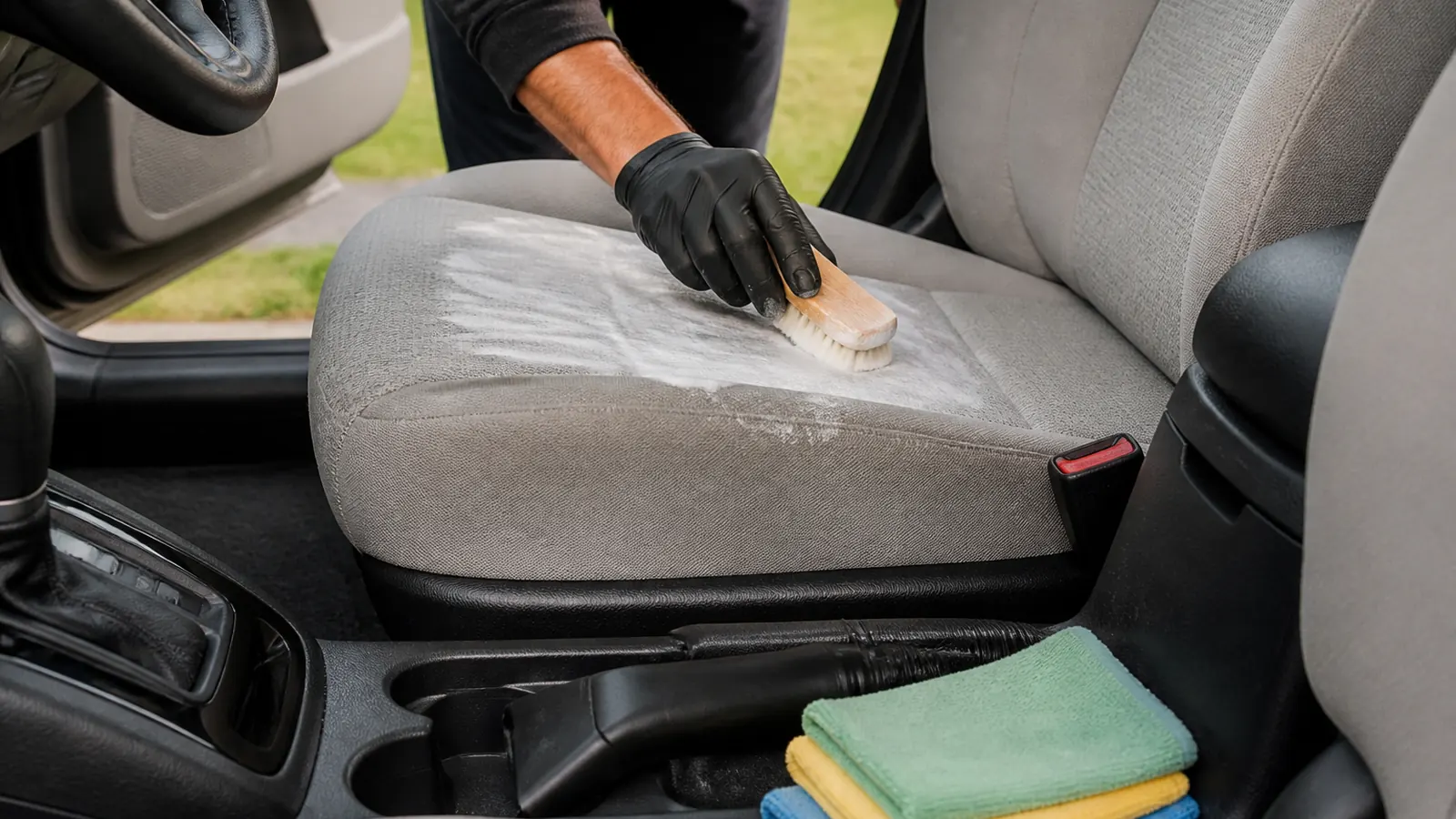
What you will need
The list is short, and half of it is already there at any self-service bay.
The vacuum is the main tool; without it the rest is pointless. The one at the bay will do: it has strong suction and a long hose.
Microfibre cloths, several of them. One dense cloth for wet work, one short-pile for glass and plastic, one dry for the finish. This is not fussiness: a cloth that has already picked up dirt simply smears it around from then on.
A soft-bristled brush — to raise the nap and clear the seams.
An interior cleaner. A universal foam cleaner covers fabric and plastic; leather needs its own, pH-neutral one.
What is deliberately not on the list is household cleaning products. Washing-up liquid and universal kitchen sprays leave a film on plastic that then glares and collects dust, and they dry out the finish on leather.
The order: everything dry before anything wet
1. Take everything out. The mats, whatever is in the pockets and the boot, the child seat. Vacuuming around objects is pointless.
2. Vacuum thoroughly. Seats first, then the floor, the boot last — top down, so that you do not carry debris onto what is already clean. Go separately along the gap between the seat and the backrest and along the seat rails: that is where most of it collects.
3. Work the seams with a brush and vacuum again. Sand left in a seam turns into dirty sludge as soon as you add moisture.
4. Only now clean with moisture. The product goes onto the brush or the cloth rather than onto the upholstery — that way there is never too much of it.
5. Collect the residue. With a dry microfibre cloth, blotting.
6. Glass last. Everything you lifted into the air earlier settles on them.
Rubber ones with water from the gun, carpeted ones with foam and a brush. They have to be dried completely: a damp mat underfoot undoes all the rest of the work.
Fabric, leather and Alcantara — three different approaches
Fabric is the most forgiving. Foam cleaner, brush, collect the residue. Work in sections of half a seat at a time: apply it to everything at once and the cleaner will dry before you get there.
Leather and leatherette do not like alkali. Use a pH-neutral cleaner and a soft cloth, and a brush only if it is a special one with very soft bristles. After cleaning, leather needs a conditioner: the cleaner removes not only dirt but part of the protective layer, and without restoring it the finish dries out and cracks over time.
Alcantara is the most temperamental material. You must not rub it in circles: the nap mats into bald patches that cannot be raised again. You work along the nap only, and with a minimum of moisture.
Plastic and the dashboard are cleaned last, and without a glossy polish on the dashboard: the shine reflects in the windscreen and gets in the way of driving.
The main mistake is the amount of water
It seems logical: the more cleaner and water, the cleaner the result. In practice it is the other way round, and the mistake is expensive.
Water passes through the upholstery into the foam, and from the foam it no longer evaporates — metal below, fabric above. After two or three days a musty smell appears, a week later mould under the trim. You cannot get that out with a cloth; it takes a full strip-down.
So the rule is simple: the cleaner goes onto the brush, not onto the seat, and you work with minimal moisture. If you can run a finger over the upholstery afterwards and it comes away wet, there is already too much of it.
The second common slip is aggressive chemistry “to be sure”. An alkaline cleaner will remove the stain and bleach the fabric around it at the same time. On an interior that shows immediately and for good.
Drying, and why it smells afterwards
Drying is half the job, not something that happens by itself.
Leave the car with its doors open in a warm dry place for at least a few hours, better for a day. If you can, point a fan at it or turn the blower to maximum with the windows open. In winter you dry it in a heated bay: in frost the moisture does not leave, it freezes in the upholstery.
There are two reasons for a smell after cleaning. The first is that the interior has not dried out, and that is the musty note that grows over time. The second is that the dirt washed out stayed in the upholstery: the cleaner lifted it and nobody collected it. Both are cured the same way: collect the residue again and dry properly.
And honestly about the time: a proper interior clean is three or four hours of work plus a day of drying. What you do in half an hour at a bay is a tidy-up rather than a deep clean, and that is useful too — just do not confuse the two.
Frequently asked questions
What should you use to clean a car interior yourself?
You need vacuum cleaner, several microfibre cloths of different weights, a soft brush and an interior cleaner. A universal foam cleaner covers fabric and plastic; leather needs a separate, pH-neutral one. Household products are a bad idea: washing-up liquid leaves a film on plastic and dries out the finish on leather.
In what order should you clean an interior?
Everything dry before anything wet. Take out the mats and your things, vacuum thoroughly from the top down, brush out the seams and vacuum again, and only then clean with moisture, section by section. Glass comes right at the end: everything you lifted into the air earlier settles on it.
Why does the car smell after an interior clean?
Two reasons. Either the interior has not dried out — moisture stayed in the foam, and that is the musty note that grows over time into mould. Or the dirt you lifted was not fully collected. The cure is the same in both cases: go over it again with a dry microfibre cloth and dry it properly with the doors open.
How long does an interior take to dry after cleaning?
From a few hours to a full day, depending on how much moisture you used and on the weather. Dry it with the doors open in a warm dry place, ideally with a fan or the blower at maximum. In winter, only in a heated bay: in frost the moisture does not leave, it freezes in the upholstery.
Can you clean Alcantara with a brush?
Only with a special soft one and only along the nap. Circular movements mat the nap into bald patches that cannot be raised again. Alcantara needs a minimum of moisture — the cleaner goes onto the cloth, not onto the material.