
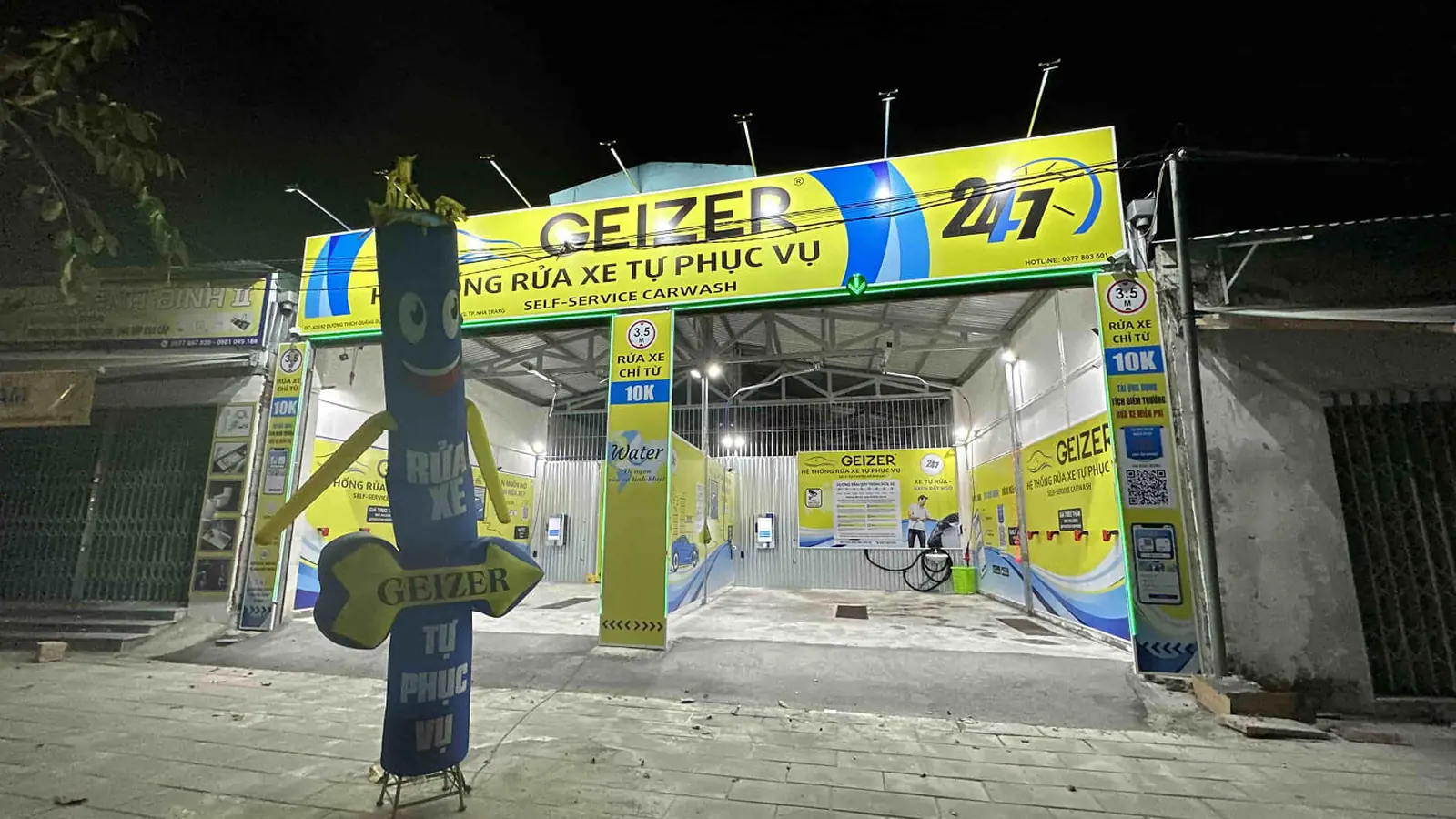
Why Vietnam at all
Vietnam is one of the fastest-growing economies in Asia, and the car fleet is growing along with incomes. There are more cars every year, and there is not enough infrastructure to look after them: self-service washes in the familiar European format are still scarce on this market.
For an entrepreneur this is a rare combination: high and growing demand with weak competition. In Russia the self-service market is already crowded, and a free spot in a good location has to be hunted for. In Vietnam the situation is closer to Russia ten years ago.
The second thing that changes the economics is the climate. A year-round season with no winter downtime: the site works 365 days a year rather than the seven or eight months of the northern regions. With identical equipment that is a difference not in comfort but in the number of working days.
The legal part: the form of the company, a foreigner's share in the capital, visas, taxes. We have no expertise of our own in these matters, and it would be dishonest to invent it — this is a local lawyer's job, and their fees go into the project budget as a separate line.
What already works there: seven sites
We are talking about a working network, not about plans. We have seven sites in Vietnam, and their geography varies — from the country's largest city to the provinces:
- Ho Chi Minh City — two sites: Sinco in the An Lạc district and Bàu Gốc.
- Nha Trang — two sites: on Phạm Văn Đồng and in the Phước Long district.
- Đắk Mil — Đắk Nông province, a small town.
- Vũng Tàu — a coastal resort city.
The spread matters more than the list: the format works both in a city of several million and in the provinces. That does not mean it will work everywhere — it means the size of the city is not in itself a verdict, and the traffic has to be counted for a specific address.
Prices at the bays: from 10,000 ₫ to wash a motorcycle and from 20,000 ₫ for a car. By Russian standards the ticket looks small, but the customer compares the cost of a visit with local prices, not Russian ones. The calculated guide for a site's revenue is from 3 million ₽ a month; that is a model rather than a guarantee, and it is set out on the page on turnkey openings.
How a Vietnamese car wash differs from a Russian one
Three differences you notice at once, and which change the calculation.
Motorcycles. Two wheels in Vietnam are not a hobby but the main way of getting around. That is a separate stream of customers with a short visit and a low ticket, something the Russian model simply does not have. It is spread more evenly through the day and fills the site nicely in the hours when there are few cars.
All year round. No winter shutdown, no heating, no downtime between seasons. What there is instead is the rainy season, and it works like a Russian winter in reverse: demand rises at that time.
A different role for the equipment. Heating for the terminal and the pipework, without which a wash in Siberia stops, is not needed here. Water treatment, on the other hand, is needed just as much: in Russia and in Vietnam alike the water can be such that without it both the station and the result of the wash suffer — on water and osmosis there is a separate article.
What gets underestimated
The commonest mistake is to treat Vietnam as a warm Russia where everything is the same, only without snow. Four things that usually get underestimated.
- Language and contractors. Without a local team, negotiations with builders, landlords and utilities become the biggest item of expenditure — in time rather than in money.
- Equipment logistics. The station travels from Russia. That is not a problem, but it is a lead time to be built into the plan rather than discovered along the way.
- The legal side. It is handled by a local lawyer, and their work goes into the budget in advance. Saving money at this step costs more than the saving.
- The location. The rules for choosing a place are the same as in Russia: traffic, a convenient entrance, competitors within a couple of kilometres. But the familiar reference points do not work — it has to be assessed on the ground.
And an honest caveat about our experience: we know our own segment — self-service car washes. We cannot speak for other niches, and advising on “what business to open in Vietnam” in general would be a conversation beyond our competence.
Where to start
The order is the same as in Russia, and it is the reverse of the usual one. Not with looking for premises but with a conversation about the task: what budget, in which city, how many bays make sense. From that comes the financial model, from the model the requirements for the site, and only then the search for a place that meets them.
After that comes choosing the location on the ground, manufacturing the equipment, logistics, installation and launch. Once open, the whole operational side is handled remotely: a self-service wash works without staff, and the owner sees the revenue and the state of the station from another country.
If you are working out the investment, start with the step-by-step calculation: the five numbers there are the same, only the currency and the traffic change.
Frequently asked questions
Can a foreigner open a business in Vietnam?
Yes, foreigners do run businesses in Vietnam, and we run seven sites there ourselves. The legal side — the form of the company, the paperwork and the taxes — is handled by a local lawyer: that is a separate budget item, and it is not something we advise on. Operationally the business is run in Russian: dealing with local contractors is taken on by the team on the ground.
What business should you open in Vietnam?
The honest answer: we know one segment — self-service car washes — and we cannot speak for other niches. In our segment Vietnam works for three reasons: a growing car fleet, a year-round season with no winter downtime, and few sites in the familiar format. Any niche still has to be checked against the traffic at a specific location.
What does it cost to open a car wash in Vietnam?
The equipment costs the same as in Russia: from 450,000 ₽ per bay with delivery, installation and launch. Everything else is different — rent, connections, contractors and the logistics of getting there. That is why the budget is calculated for a specific city and site rather than from an average figure.
Do you need to speak Vietnamese?
No. Support is provided in Russian at every stage — from choosing the location to the launch — and negotiations with local builders, suppliers and services are taken on by the team on the ground. Experience in the car wash business is not required either: the site works without staff and is monitored remotely.
How does a Vietnamese car wash differ from a Russian one?
In three ways. There is a stream of motorcycles — separate customers with a short visit. There is no winter, so the site works 365 days a year, and the rainy season brings a rise in demand rather than a slump. And there is no need to heat the terminal and the pipework, while water treatment is needed just as much.