
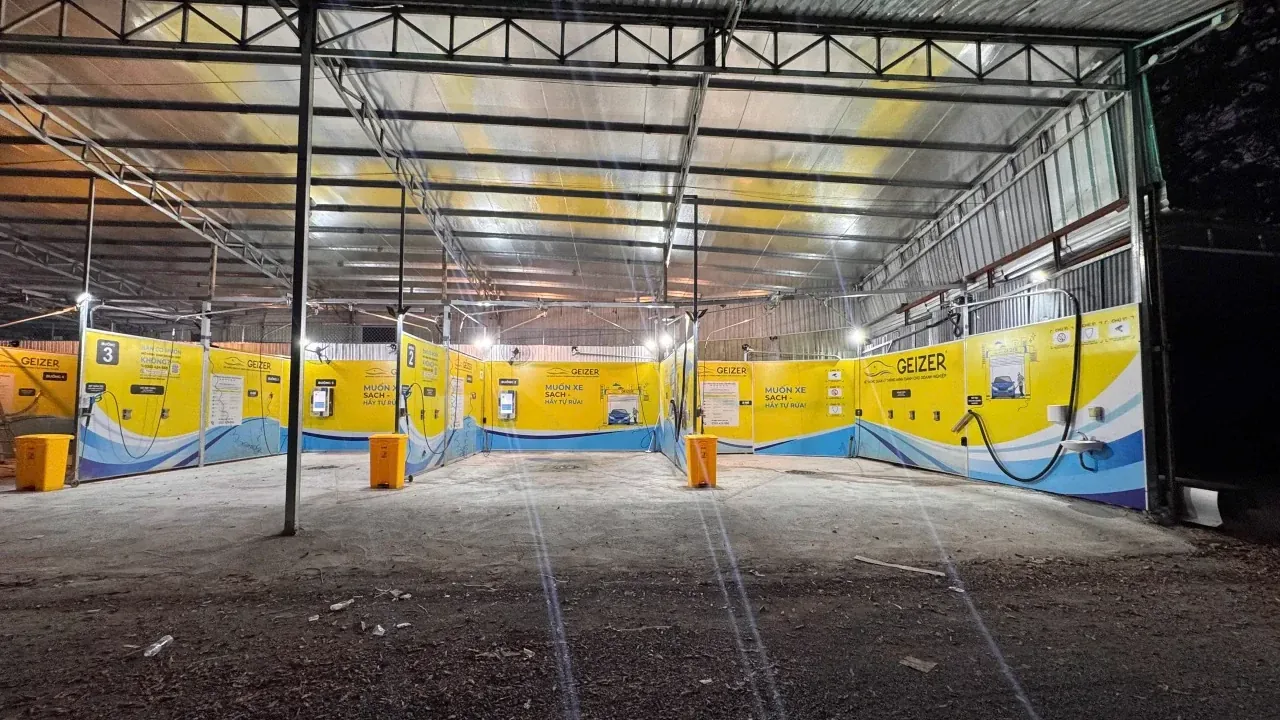
Where the sites are
Seven sites, and they are deliberately different in scale:
- Ho Chi Minh City — two sites: Sinco in the An Lac district and Bau Goc. The country's largest city.
- Nha Trang — two sites: on Pham Van Dong and in the Phuoc Long district. A resort town.
- Vung Tau — the coast, a resort flow.
- Dak Mil — Dak Nong province, a small town with no tourism.
- Tan Thanh — Dong Thap province.
The spread matters more than the list. The format works both where millions live and where a few tens of thousands do. That does not mean it works everywhere: you still have to count traffic at the specific address, not by the size of the town. But the size of the town on its own is not a verdict.
The addresses of all sites with a map are on the Vietnamese page of washes — it is made for local customers and written in Vietnamese.
How a bay is arranged
The arrangement is the same as in Russia, and that is the point: the station is identical, what changes is the environment around it.
A driver pulls into a bay, picks a programme on the touch panel and pays right there. The panel doubles as the payment terminal — there is no separate till and no cashier at the bay. Then he washes the car himself: high-pressure water, foam, wax, air dry. None of our sites has staff at the bays.
The owner does need someone on site — to clean the grounds, load chemicals and handle small jobs. That is a few hours, not a full day. Revenue per bay, load and fault alerts are visible in the online account from a phone, so being there every day is not required — including from another country.
What the station itself is built from — the high-pressure pump group, chemical dosing, control electronics and the panel — is set out in a separate article.
Two streams instead of one
The main difference from Russia is visible at any site within minutes: motorbikes. Two-wheeled transport here is not a weekend hobby but the main way of getting around.
For a wash this is a second stream of customers with its own behaviour: the visit is short, the ticket is low, but there are more of them and they are spread more evenly through the day. Motorbikes fill the site in the hours when cars are scarce — that is, they even out the load rather than merely adding revenue.
Bay prices: from 10,000 ₫ for washing a motorbike and from 20,000 ₫ for a car. By Russian standards the ticket looks tiny. But the customer compares it with local prices and local incomes, not with Russian ones — and on that scale the visit costs exactly what it should.
All year round, no winter
The second difference is the calendar. In the northern regions of Russia a site lives seven or eight months: in winter some washes stop because of frost, the terminal and pipework need heating, and there is an off-season. In Vietnam none of that exists: the site works 365 days.
The rainy season works like a Russian winter in reverse. A car gets dirty faster, and demand at that time does not fall but rises.
For the equipment this means: the heating without which a wash in Siberia would stop is not needed here. Water treatment, however, matters just as much — water can be such that both the station and the wash result suffer without it. Whether a particular site needs it is shown by a water test on the spot, not by the region. There is a separate breakdown.
What it takes to open one like it
Equipment — from 450,000 ₽ per bay including delivery, installation, commissioning and training. The same as in Russia: we manufacture the station in Barnaul and ship it from there.
Everything else is calculated for the specific address: rent or land, site preparation, canopies, water and power connections, contractors, a lawyer. This part varies far more than the equipment itself and usually decides whether the project adds up. What goes into it is set out in the article about the budget.
The calculated benchmark for revenue is from 369,000 ₽ a month per bay. This is a model, not a guarantee of income: the result depends on the location, the traffic and how the site operates.
The revenue of specific sites: that is partners' data and we have no right to publish it. And the legal part — company form, foreign ownership share, visas and taxes: we have no expertise of our own, that is the work of a local lawyer.
Frequently asked questions
How many GEIZER washes are there in Vietnam?
Seven working sites: two in Ho Chi Minh City, two in Nha Trang, plus Vung Tau, Dak Mil and Tan Thanh. The addresses with a map are published on the Vietnamese page of washes.
What does washing a car at such a wash in Vietnam cost?
At our bays — from 10,000 ₫ for washing a motorbike and from 20,000 ₫ for a car. The customer pays at the panel by card, QR code or contactless and washes the vehicle himself.
Does the wash work in the rainy season?
Yes, and demand rises during it: a car gets dirty faster. Winter shutdown and an off-season do not exist in Vietnam at all — the site works 365 days a year.
Does the site need staff?
At the bays — no, the customer serves himself. The site does need someone to clean the grounds, load chemicals and handle small jobs; how many hours that takes depends on the number of bays and the traffic. Revenue and the state of the station are visible in the online account from a phone.
How does a Vietnamese wash differ from a Russian one?
In three ways. A motorbike stream appears — separate customers with a short visit. There is no winter: the site works all year round, and the rainy season raises demand. And the terminal and pipework need no heating, while water treatment is needed just the same.